I The Galton board
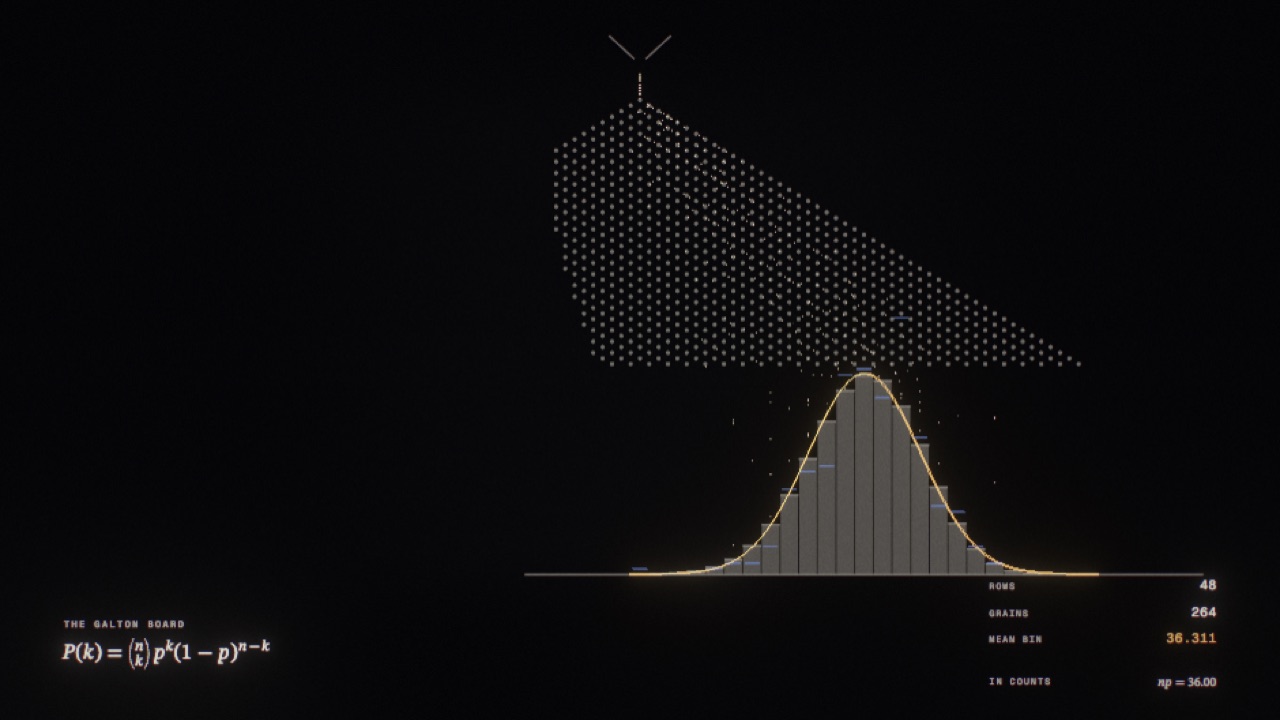
Francis Galton built this board in 1873 to show order coming out of chance. At every peg a ball bounces left or right with even odds, so the bin it lands in, counted from the left, is the number of times it went right: k=b1+b2+⋯+b12. There are 212=4096 equally likely paths, and 12k of them end in bin k. Drop enough balls and the share of each bin settles near 12k/4096; add rows and they settle onto the bell curve. In the corner the balls are counted as they land.
- Left or right
- k=b1+b2+⋯+b12One ball, slowly. At each of the twelve pegs it goes right or left, and the corner writes its path down as it goes, R for right and L for left. It goes right seven times, so it lands in bin 7. Nine more follow it down.
- Counting paths
- P(k)=12k/212The number at each peg counts the paths that reach it, the sum of the two numbers above, so the pegs spell out Pascal's triangle, and each line between them is lit by the chance that a ball runs along it. The gold lines are the 127=792 paths, out of 4096, that end in bin 7.
- A thousand balls
- Nk/N→12k/212Fourteen hundred balls, each on its own path. The blue outline is where the piles should stand, N times the probability of each bin, and the piles keep close to it, closer in proportion the more balls fall: the law of large numbers.
- The bell curve
- nk/2n≈√2/πne−2(k−n/2)2/nThe rows double, from 12 to 192, and the board is rescaled each time to keep the spread the same. The bars, whose areas are the exact probabilities of each bin, close in on the gold curve e−x2/2. De Moivre found this in 1733; it is the first case of the central limit theorem.