yAtlas

最初のコマを描いています…

0:00 / 6:24Prologue

ひそむ秩序 · No.07 · リアルタイム描画の短編 · 6:24

Curvature

A short film about differential geometry

Differential geometry in five short chapters. How sharply a curve bends at a point is a number, and so is how a surface bends: positive like a ball, negative like a saddle. Curvature changes from point to point. Added up, it keeps an order: once round a closed curve, the tangent turns a whole number of times; however a sphere is squeezed, its total curvature stays 4π; a doughnut adds up to zero. That order ignores the shape and counts only turns and holes. In between come soap films whose two bends cancel at every point, and straight paths that leave one point of a sphere and meet again on the far side. Every frame is computed by code; on the website, each one is drawn live in your browser as the film plays.

上映時間
6:24
構成
五つの章と、プロローグ、エピローグ
解像度
再生エリアに合わせて自動調整(最大 440 万画素)
フレームレート
最大でディスプレイのリフレッシュレート(実際は端末の性能による)
事前に録画したコマ
なし
言語
中文 · English

自分で試す

下に挙げた場面は、映画の絵をそのまま Studio で開き、自分の手で動かせる。

  1. Drag the osculating circle round the ellipseI · How much a curve bends
  2. Try other curves and count the verticesI · How much a curve bends
  3. Bend the catenoid into a helicoid yourselfIII · Soap films

章

Studio

この巻の画面を、自分の手で。パラメータを変えて、画面がどう変わるかを見る。

ナレーション原稿 · 79
  1. Prologue

  2. IHow much a curve bends

  3. IIGaussian curvature

  4. IIISoap films

  5. IVGeodesics

  6. VTotal curvature

  7. Coda

図版の解説 · 5

I The osculating circle

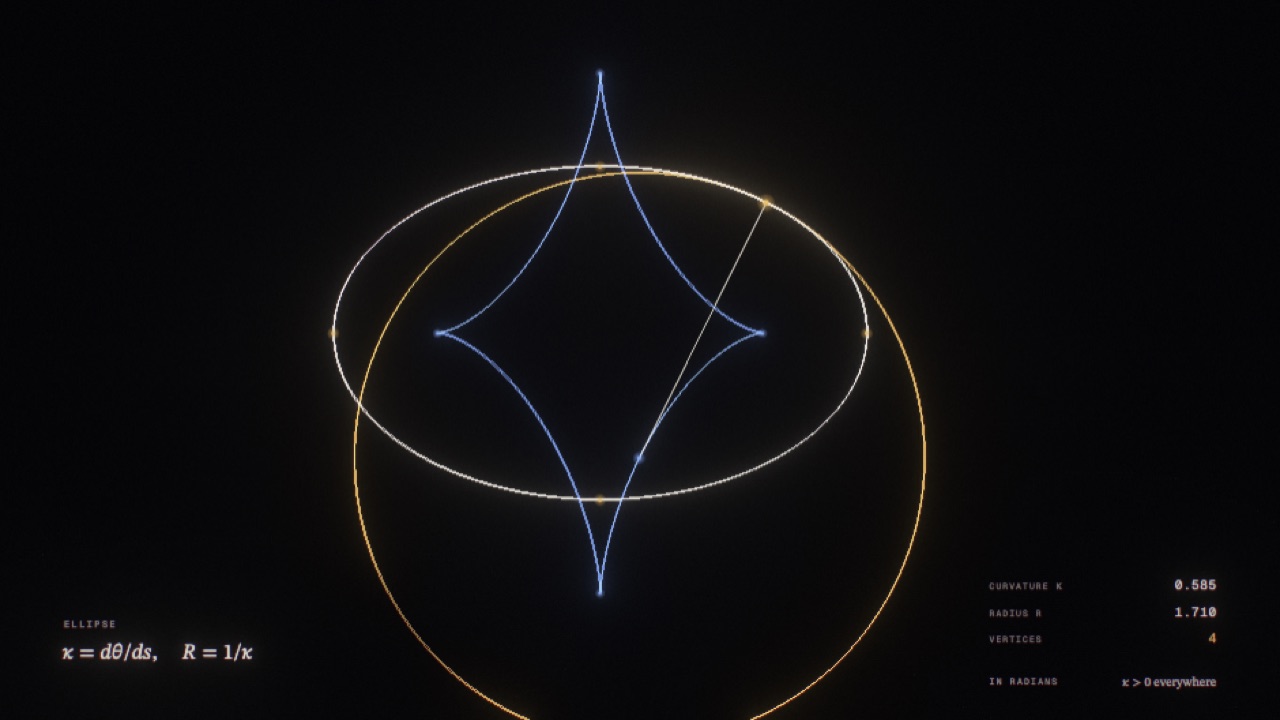
Walk along a curve and the direction you face turns: curvature is how fast, κ=dθ/ds, radians per unit of length, positive for a left turn and negative for a right one. At each point the circle that hugs the curve best, the osculating circle, has radius 1/|κ| and its centre on the normal; at an inflection it opens out into a straight line. Here the circle travels round an ellipse and its centres trace the evolute, the curvature is drawn as a comb, every normal is drawn at once and they crowd into the evolute, and the tangent is followed round three closed curves. In the corner the turning is measured in radians.

The osculating circle
κ=dθ/ds,R=1/κA point runs once round an ellipse whose axes are in the ratio 1.6:1. The gold circle is the osculating circle, of radius 1/κ: smallest at the ends of the long axis, where κ=1.6, largest at the ends of the short one, where κ=1/1.62≈0.39. Its centre, in blue, traces the evolute, a star with four cusps.
The comb
κ=(x′y′′−y′x′′)/(x′2+y′2)3/2Each tooth is a normal whose length is in proportion to the curvature where it stands. The ellipse turns into a peanut, which is no longer convex: across its waist the curve bends the other way, the curvature is negative and the comb flips inside, and the four points where it changes sign are the inflections. Then the peanut rounds out into an egg.
Four vertices
vertices≥4Draw every normal and they crowd into their envelope, the evolute, whose cusps stand over the vertices, the points where the curvature is greater, or smaller, than on either side. An egg has four, a rounded triangle six, a rounded square eight. The four-vertex theorem says no simple closed curve has fewer than four: Mukhopadhyaya proved it for ovals in 1909, and Kneser for every simple closed curve in 1912.
Turning
∫κds=2πnFollow the tangent once round a closed curve and add up its turning. For the ellipse it is 2π, one full turn; for a figure eight, which turns right and then left, 0; for a limaçon with a loop inside it, 4π. The dial on the right unwinds the total. No deformation that keeps the curve smooth, with a tangent everywhere, can change that number, which is why the three are swapped rather than bent into one another: the theorem of Whitney and Graustein, 1937.

II Gaussian curvature

Cut a surface with a plane through its normal and the cut is a curve with its own curvature. As the plane turns, that curvature swings between two extremes, the principal curvatures κ1 and κ2, following Euler's formula. Their product K=κ1κ2 is the Gaussian curvature: positive where the surface curves like a ball, negative where it curves like a saddle. Gauss showed in 1827 that K can be found without leaving the surface, from lengths alone, so no bending without stretching can change it. In the corner the curvatures and the solid angles are read off.

Two curvatures
κ(φ)=κ1cos2φ+κ2sin2φOn the outside of the torus the plane through the normal turns once round, and the gold arc, the osculating circle of the cut, swings between the radius of the outer rim and the tube's: both bend the same way. On the inside of the ring they bend opposite ways, and twice in every half turn the gold arc straightens out, where the cut does not bend at all.
A torus
K=κ1κ2Coloured by K: warm on the outside, where the torus is shaped like a ball, cold on the inside, where it is shaped like a saddle, and zero along the two circles on top and underneath, where the surface does not bend in the direction of the circle. The probe walks from the outer equator over the top to the inner one.
The Gauss map
K=limΩ/ASend each point to its unit normal and a small loop on the torus becomes a loop on the sphere of directions. The solid angle it encloses, divided by the area of the loop, tends to K as the loop shrinks. Outside, the image turns the same way as the loop; on top it folds over on itself; in the hole it turns the other way, and the ratio is negative.
Theorema egregium
K=0→K=1A flat sheet has K=0, and it rolls into a cylinder without stretching anything, so the cylinder has K=0 too. Pressed onto a sphere, where K=1, the same sheet has to change its lengths: Gauss's remarkable theorem, and the reason no flat map of the Earth is true to scale. Pressed the way shown here, the lengths at the edges shrink by more than half.

III Geodesics

Walk forwards on a surface without ever turning left or right and you trace a geodesic: its acceleration points straight out of the surface, along the normal. Geodesics are the locally shortest paths. On a sphere they are the great circles; on a surface of revolution they obey Clairaut's relation; on an ellipsoid with three different axes, those leaving a point fold into the envelope Jacobi described, whose four cusps were proved only in 2004. In the corner the arcs and the angles are measured, in radians.

Straightest paths
γ(s)=cossP0+sinseThirty-six great circles leave one point of the unit sphere in every direction. They spread apart as sins, widest a quarter of the way round, and after an arc of exactly π they all meet again at the opposite point: on a sphere every direction leads to the antipode, and no path along a great circle is shortest beyond it.
The shortest route
cosd=sin2φ+cos2φcosΔλTwo cities on the 45th parallel, 150° of longitude apart. Following the parallel takes an arc of 1.851; the great circle, which bends towards the pole, takes 1.504, nearly a fifth shorter. That is why flights between Europe and the west of North America often pass over Greenland.
Clairaut's relation
ρcosψ=cOn a surface of revolution a geodesic keeps ρcosψ constant, where ρ is its distance from the axis and ψ its angle to the parallel. Launched from the outer equator at three angles, one stays on the outside between the two circles where ρ=c, one reaches over the top but cannot pass through the hole, and one, whose c is smaller than the radius of the hole, winds through it again and again.
Jacobi's ellipsoid
x2/a2+y2/b2+z2/c2=1On an ellipsoid with three different axes, 360 geodesics leave one point. On the far side they begin to cross, and crowd into a bright envelope, the conjugate locus, a curved astroid with four cusps. Jacobi described it in the 1840s and asserted that, from any point that is not an umbilic, it has exactly four cusps; the statement was proved by Itoh and Kiyohara in 2004.

IV Gauss–Bonnet

On a curved surface the angles of a triangle whose sides are geodesics do not in general add up to π: Gauss proved in 1827 that the difference is the curvature enclosed, α+β+γ−π=∫∫KdA. Bonnet extended it in 1848 to regions bounded by any curve. Over a whole closed surface the theorem becomes a count: the total curvature is 2πχ, where the Euler characteristic χ is 2 for a sphere and 0 for a torus. Curvature can be moved about the surface, but not created or destroyed. In the corner the angles and the curvatures are added up, in radians.

Angle excess
α+β+γ−π=∫∫KdAA triangle on the unit sphere, its sides arcs of great circles, opens from a small one, nearly flat, to about a sixth of the sphere. The sum of its angles grows from barely more than π, as in the plane, to 5.3146, and the excess over π matches, to four decimals, the area computed separately from where its corners are: on a sphere, where K=1, the curvature enclosed is the area.
Parallel transport
Δθ=∫∫KdAA vector is carried round the triangle without ever turning, kept as parallel to itself as the sphere allows; along each side, a great circle, it keeps the same angle to the side. It comes back turned by 2.1730, the triangle's area. Carried round the latitude of Paris, 48.85°, it comes back turned by 1.5523, the area of the cap to the north, which is the same as turning the other way by 2πsinφ: how far the swing of Foucault's pendulum turns in a sidereal day.
Total curvature
∫∫KdA=4πFour bumps rise out of a sphere and two dents sink into it. On the tops of the bumps K climbs to nearly 6, and round their skirts the surface turns into a saddle, where K<0; the colour follows K. However high they rise, the curvature gained on the tops is lost round the skirts, and the total, summed in the corner over 3,456 points of the surface in every frame, each weighted by the area it stands for, stays 4π.
A handle
∫∫KdA=2πχA torus has one handle, and χ=0. A band spreading from the outer equator gathers positive curvature, 4πsinv, as much as a whole sphere by the time it covers the outer half; carried on over the top and into the hole it gathers as much negative curvature, and closes on 0. A closed surface with g handles has χ=2−2g, and a total curvature of 4π(1−g), however it is shaped.

V Minimal surfaces

A surface is minimal when no small change to any small piece of it can reduce its area, and Meusnier showed in 1776 that this is the same as having mean curvature zero, H=(κ1+κ2)/2=0: at every point it bends as much one way as the other. Soap films are minimal surfaces, which is why Plateau spent years dipping wire frames into soapy water; that every simple closed wire spans one was proved by Radó and by Douglas around 1930. Here a film is stretched between two rings until it breaks, the principal curvatures of a catenoid are measured, a catenoid is bent into a helicoid, and Enneper's surface is grown from a small disc. In the corner the areas and the curvatures are measured.

A soap film
r=acosh(x/a)Two rings of radius 1 are drawn apart, and the film between them, a catenoid, thins at the waist. Beyond a separation of 1.0554 it has more area than the two discs it could collapse into, yet it holds, since no nearby shape is smaller. At 1.3255 no catenoid can span the rings any more, and the film snaps into two flat discs, the solution Goldschmidt described in 1831.
Mean curvature zero
κ1+κ2=0On a catenoid the meridian, a catenary, bends away from the axis, and the normal section along the parallel bends towards it by exactly as much. The gold and blue circles are the osculating circles of these two principal sections, both of radius cosh2v, on opposite sides; away from the waist the section along the parallel is no longer the parallel circle itself. The probe walks along a meridian and the mean curvature in the corner stays 0, while the Gaussian curvature, K=−1/cosh4v, is negative everywhere.
Catenoid to helicoid
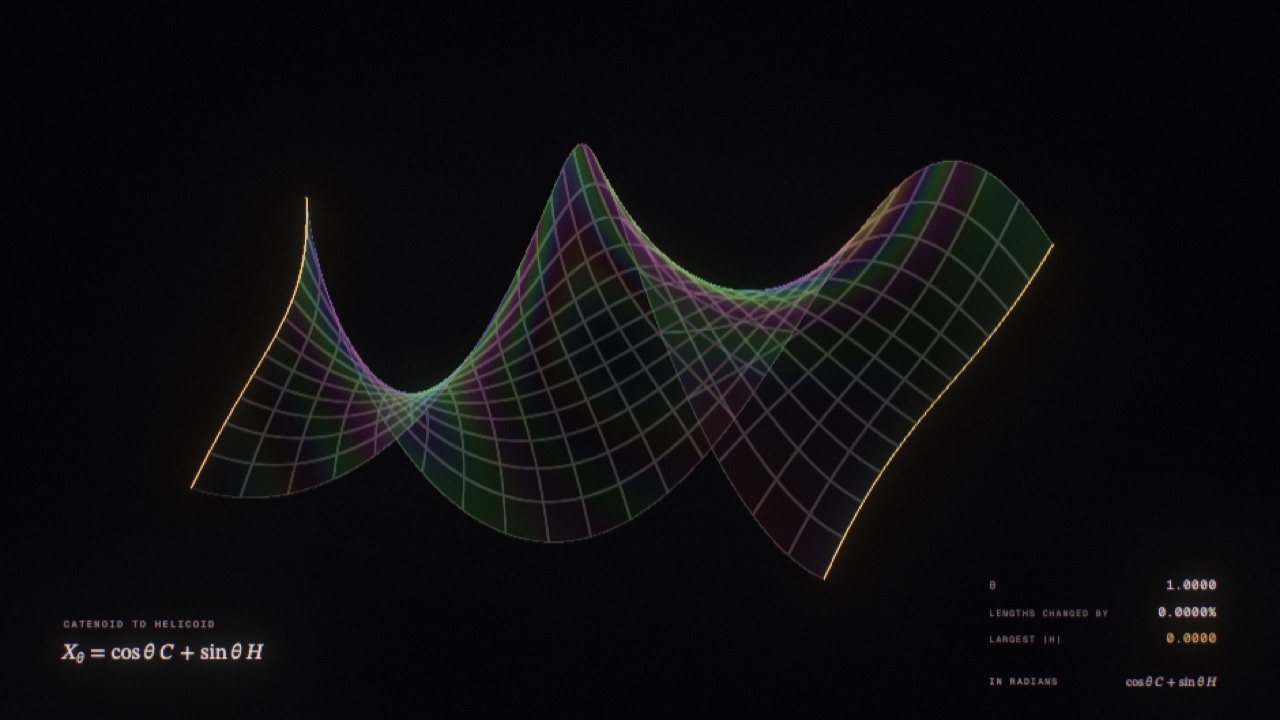
Xθ=cosθC+sinθHCut along a meridian, the gold edges, the catenoid bends into a helicoid and back without stretching: every surface Xθ of the family is minimal, and all of them have the same lengths, ds2=cosh2v(du2+dv2), and the same normals. The circle round the waist straightens into the axis of the helicoid. The corner measures how far the lengths and the mean curvature drift from the catenoid's: nowhere, to four decimals.
Enneper's surface
∫∫KdA=−4πr2/(1+r2)In 1864 Enneper found a minimal surface given by polynomials. Grown from a small disc, it is a saddle whose edge rises and falls twice, and once the disc is larger than r=√3 the surface passes through itself. Its total curvature, −4πr2/(1+r2), tends to −4π, as does the catenoid's: Osserman showed in 1964 that these two are the only complete minimal surfaces whose total curvature is −4π.