I The osculating circle
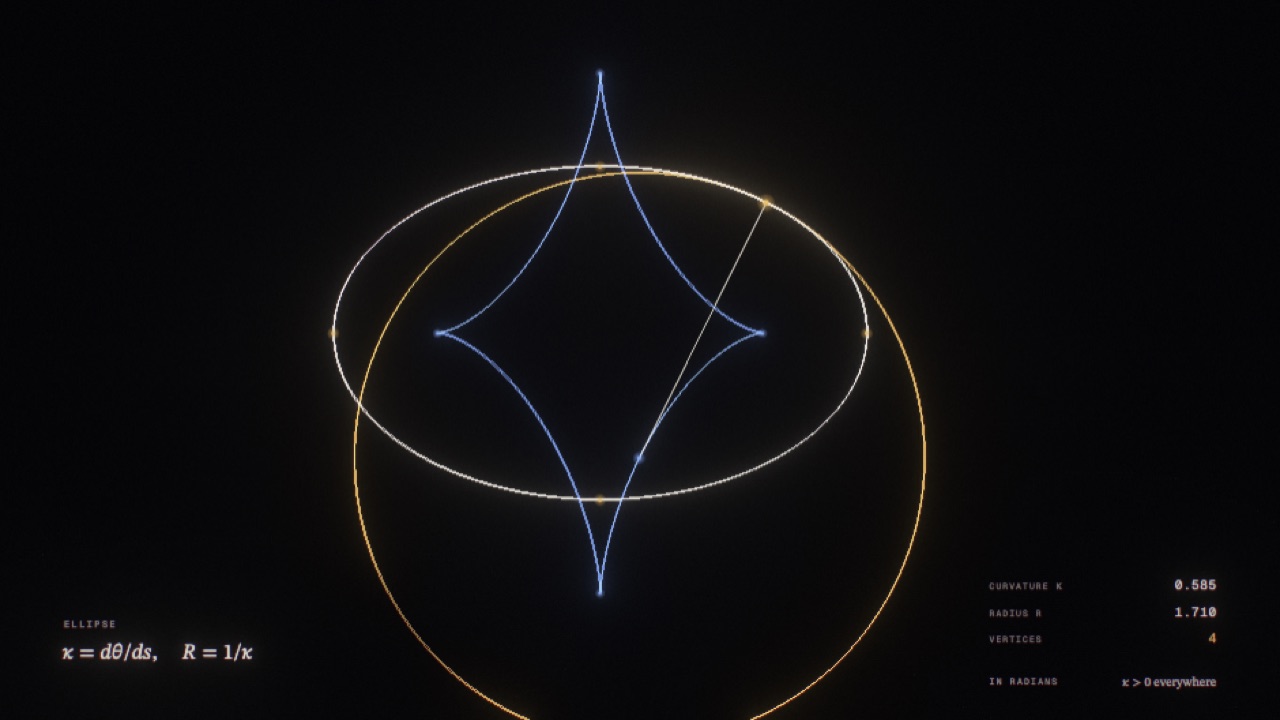
Walk along a curve and the direction you face turns: curvature is how fast, κ=dθ/ds, radians per unit of length, positive for a left turn and negative for a right one. At each point the circle that hugs the curve best, the osculating circle, has radius 1/|κ| and its centre on the normal; at an inflection it opens out into a straight line. Here the circle travels round an ellipse and its centres trace the evolute, the curvature is drawn as a comb, every normal is drawn at once and they crowd into the evolute, and the tangent is followed round three closed curves. In the corner the turning is measured in radians.
- The osculating circle
- κ=dθ/ds,R=1/κA point runs once round an ellipse whose axes are in the ratio 1.6:1. The gold circle is the osculating circle, of radius 1/κ: smallest at the ends of the long axis, where κ=1.6, largest at the ends of the short one, where κ=1/1.62≈0.39. Its centre, in blue, traces the evolute, a star with four cusps.
- The comb
- κ=(x′y′′−y′x′′)/(x′2+y′2)3/2Each tooth is a normal whose length is in proportion to the curvature where it stands. The ellipse turns into a peanut, which is no longer convex: across its waist the curve bends the other way, the curvature is negative and the comb flips inside, and the four points where it changes sign are the inflections. Then the peanut rounds out into an egg.
- Four vertices
- vertices≥4Draw every normal and they crowd into their envelope, the evolute, whose cusps stand over the vertices, the points where the curvature is greater, or smaller, than on either side. An egg has four, a rounded triangle six, a rounded square eight. The four-vertex theorem says no simple closed curve has fewer than four: Mukhopadhyaya proved it for ovals in 1909, and Kneser for every simple closed curve in 1912.
- Turning
- ∫κds=2πnFollow the tangent once round a closed curve and add up its turning. For the ellipse it is 2π, one full turn; for a figure eight, which turns right and then left, 0; for a limaçon with a loop inside it, 4π. The dial on the right unwinds the total. No deformation that keeps the curve smooth, with a tangent everywhere, can change that number, which is why the three are swapped rather than bent into one another: the theorem of Whitney and Graustein, 1937.