I Times tables
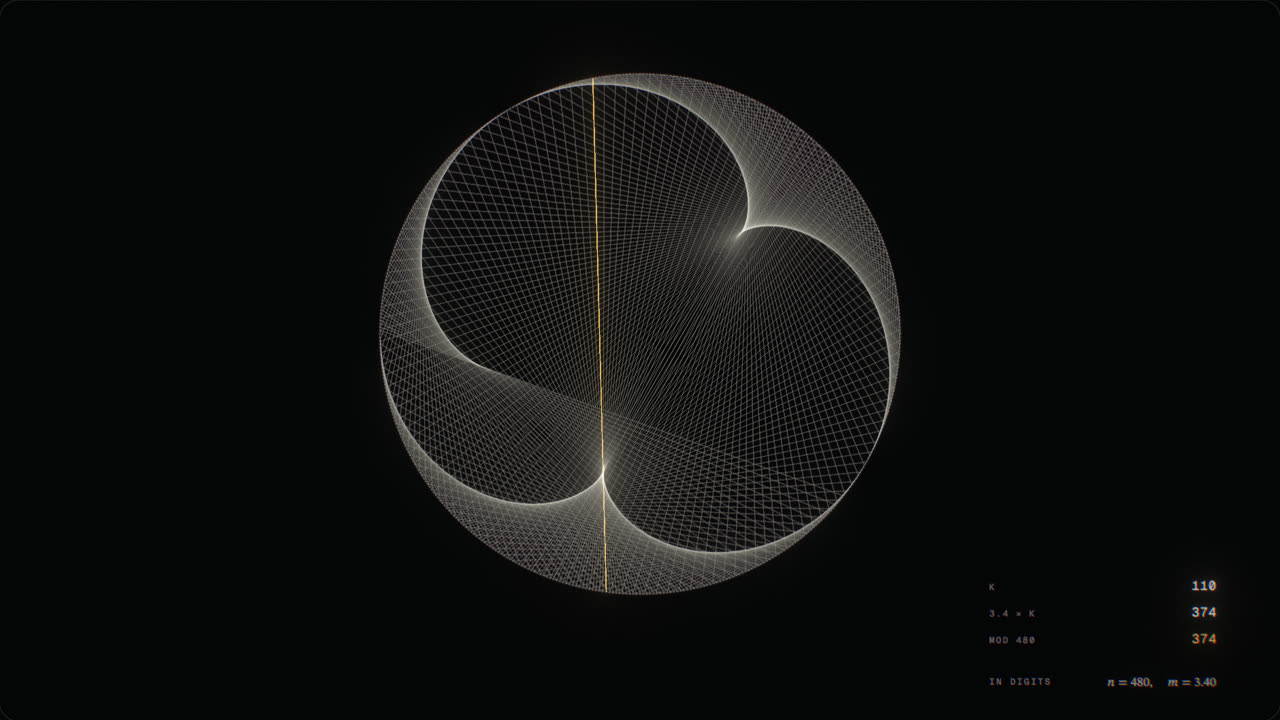
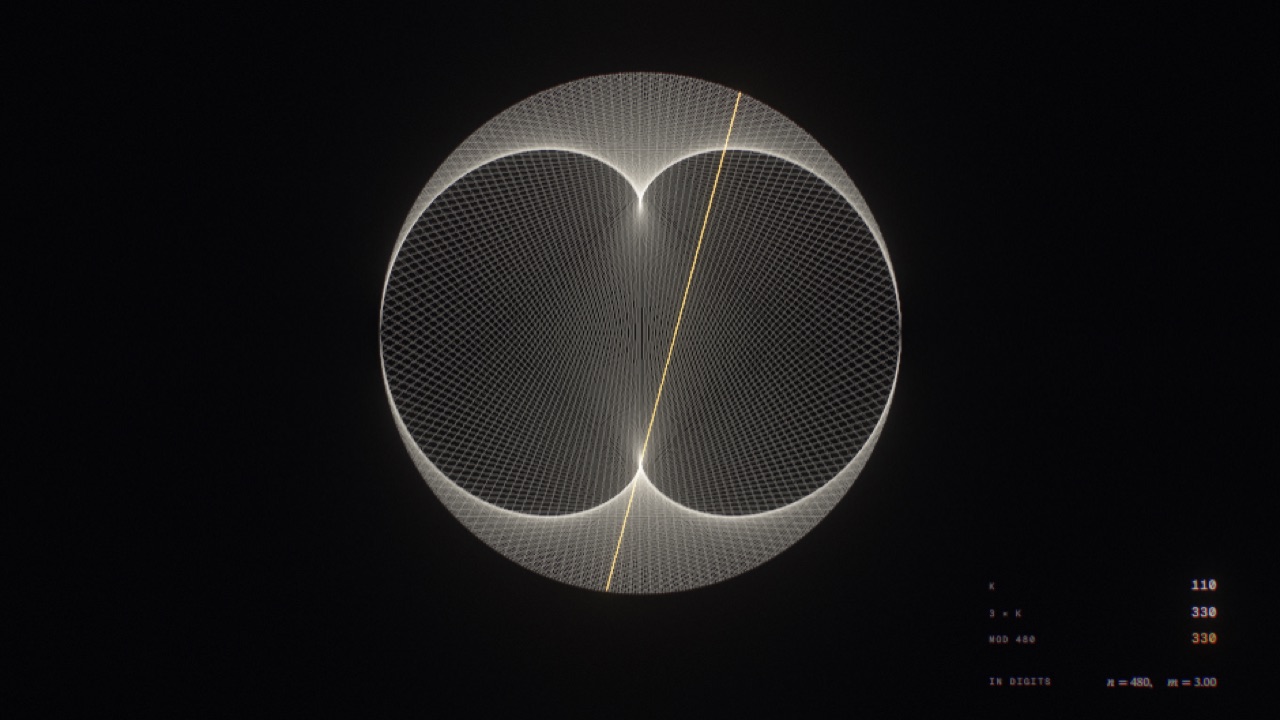
Number the points of a circle from 0 to n−1 and draw a chord from every k to mk, counting round the circle, so modulo n. Each chord is one line of a times table; together they bend into the curve they all touch, their envelope. For m=2 it is a cardioid, for m=3 a nephroid, and for every m an epicycloid with m−1 cusps. The chords are drawn by the GPU as hairlines of light that add up where they overlap, so the envelope shines. In the corner the chord under the gold highlight is worked out in digits.
- Doubling
- k↦2kmodnTen points and the chords 1→2, 2→4, 3→6, and on round the circle: 6→12, which is 2 modulo 10. As the points multiply, the chords close in on a heart-shaped curve, the cardioid, which touches the circle at 0 and has its one cusp on the far side, a third of the way out from the centre.
- Every multiplier
- k↦mkmodnWith 480 points the multiplier walks from 2 to 10, and not only through whole numbers: between them the envelope is torn open at 0, where its next cusp is growing. When the multiplier is a whole number m, the envelope closes into an epicycloid with m−1 cusps, the curve traced by a point on the rim of a wheel rolling round the outside of a fixed circle.
- Resonance
- m=n/q+2Some large multipliers draw small ones several times over. If m=n/q+2, then mk is 2k plus k q-ths of a turn, so the chords fall into q families by the remainder of k modulo q, each one the doubling table turned a q-th of a turn further than the last: 242, 162, 122, 98 and 82 draw two, three, four, five and six cardioids.
- A coffee cup
- θ↦2θ→θ↦3θ+πA lamp on the rim of a cup: a ray from it that strikes the wall at the angle θ is reflected to strike it again at 2θ, so the reflected rays are the doubling table and their envelope, the caustic on the coffee, is a cardioid. As the lamp moves away the rays turn parallel, and sunlight, all parallel, is reflected from θ to 3θ+π, the tripling table turned a quarter of a turn: half a nephroid, the curve you see in a real cup.