I Linear flows
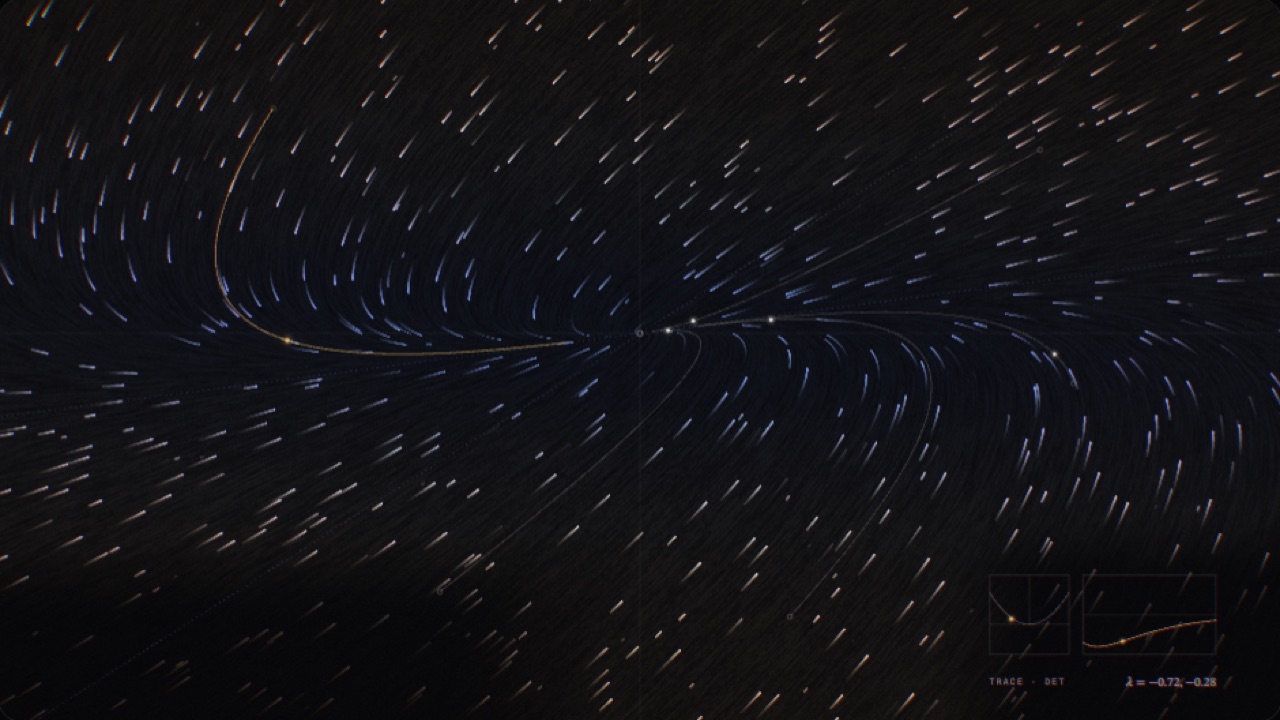
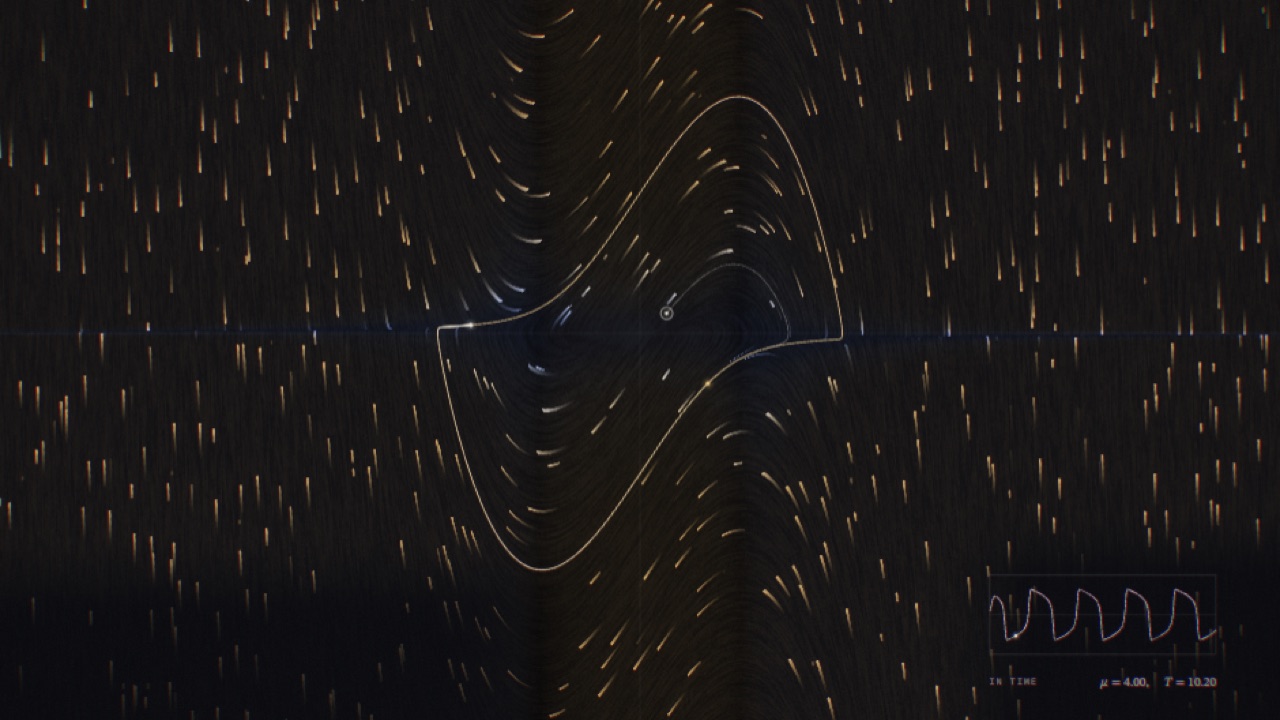
A differential equation x′=Ax puts an arrow at every point, and its solutions are the curves that follow them. For a two-by-two matrix the kind of motion is decided by its trace τ and its determinant Δ, because the eigenvalues solve λ2−τλ+Δ=0. Here the matrix walks a loop through the trace–determinant plane, and each frame shows the flow of the matrix it has reached; the plane is drawn in the corner with the parabola Δ=τ2/4 that divides real eigenvalues from complex ones. Every pixel follows the flow upstream, the comets run along the streamlines, and beside the plane the gold orbit's first coordinate is plotted against time.
- Node
- x′=Ax,λ1<λ2<0Both eigenvalues are real and negative. Every orbit falls towards the origin, and all but the two on the faster eigendirection arrive along the slower one, the one that belongs to λ2.
- Spiral
- λ=τ/2±i(Δ−τ2/4)1/2Across the parabola the eigenvalues turn complex. The imaginary part sets the orbits turning and the real part τ/2 still draws them in: a spiral sink.
- Centre
- τ=0,x(t)=eAtx0With zero trace and a positive determinant there is nothing to draw the orbits in or push them out. They close into ellipses, and the time plot in the corner is a pure oscillation.
- Saddle
- Δ=detA<0A negative determinant gives real eigenvalues of opposite sign. Orbits come in along one eigendirection and leave along the other; only those that start on the incoming line keep heading into the origin, and they never quite arrive. Then the matrix walks back to the node.