An atlas of mathematics
Short films and plates
The films and plates here take mathematics as their subject. The films are narrated just enough for you to follow what is happening on screen. You need not come away having learned anything, but you may well come away having seen something you had never noticed.
Latest volume
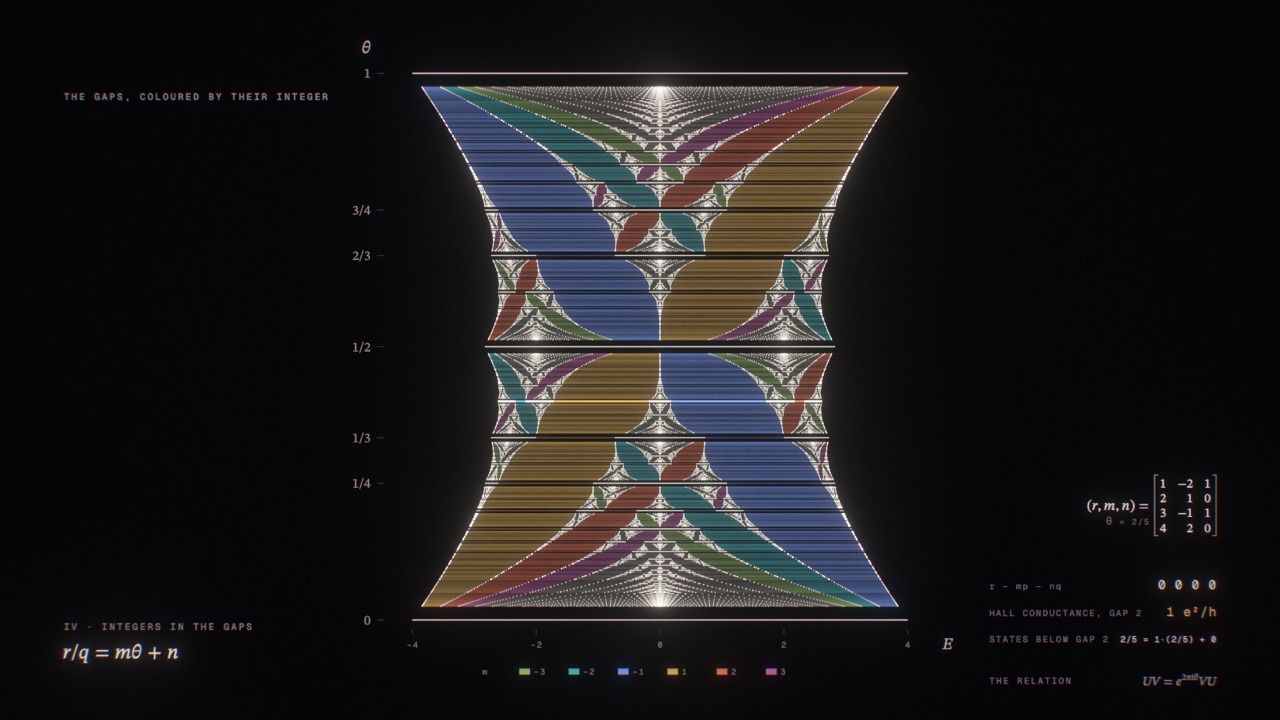 The Order Beneath · No.19 · Noncommutative geometryNoncommutativeA short film about noncommutative geometryNoncommutative geometry in five short chapters. We usually tell the points of a space apart with functions, but some spaces have points that functions cannot tell apart. A straight line of irrational slope wound round a torus never comes back to its start, but winds ever closer to every point. Lines of that slope form a whole family; treat each one as a point, and together they make a space. Yet a continuous function that takes one value on each line must be constant, so to functions this space is a single point. Alain Connes gave up the points and kept two operations on functions on a circle: one slides a function some way round the circle, the other multiplies it by a factor whose phase turns once round the circle. Swap their order, and the results differ by a single phase angle, the same everywhere. The algebra the two generate stands in for the space, and geometry can still be read in it. An electron hopping on a lattice in a magnetic field obeys the same relation; its energies, drawn one row for each value of the flux, make Hofstadter's butterfly. In a finite matrix, a projection's share is always a fraction, yet this algebra holds a projection whose share is irrational, about 0.382. And once a ruler is added (the Dirac operator D), distance and dimension can be measured without points or paths. Last comes another algebra: in the system Bost and Connes built, the energy levels are log 1, log 2, log 3 and so on. Below a critical temperature, the weights of the levels add up to a value of Riemann's zeta function; at that temperature the sum becomes infinite. At or above it there is a single equilibrium; below it there are several, a phase transition: swapping every root of unity for its conjugate turns one equilibrium into another, so at low temperature that symmetry is broken. Every frame is computed by code; on the website, each one is drawn live in your browser as the film plays.VersionsEnglish中文PlatesWatch →
The Order Beneath · Math × Shader
Under the surface of things lies a mathematical order, and this series sets out to make it visible. Each volume explores one area of mathematics, and every frame is drawn live in your browser. Invariant, the prologue, is a film; the nineteen volumes from Conformal to Noncommutative each have their film and plates online.
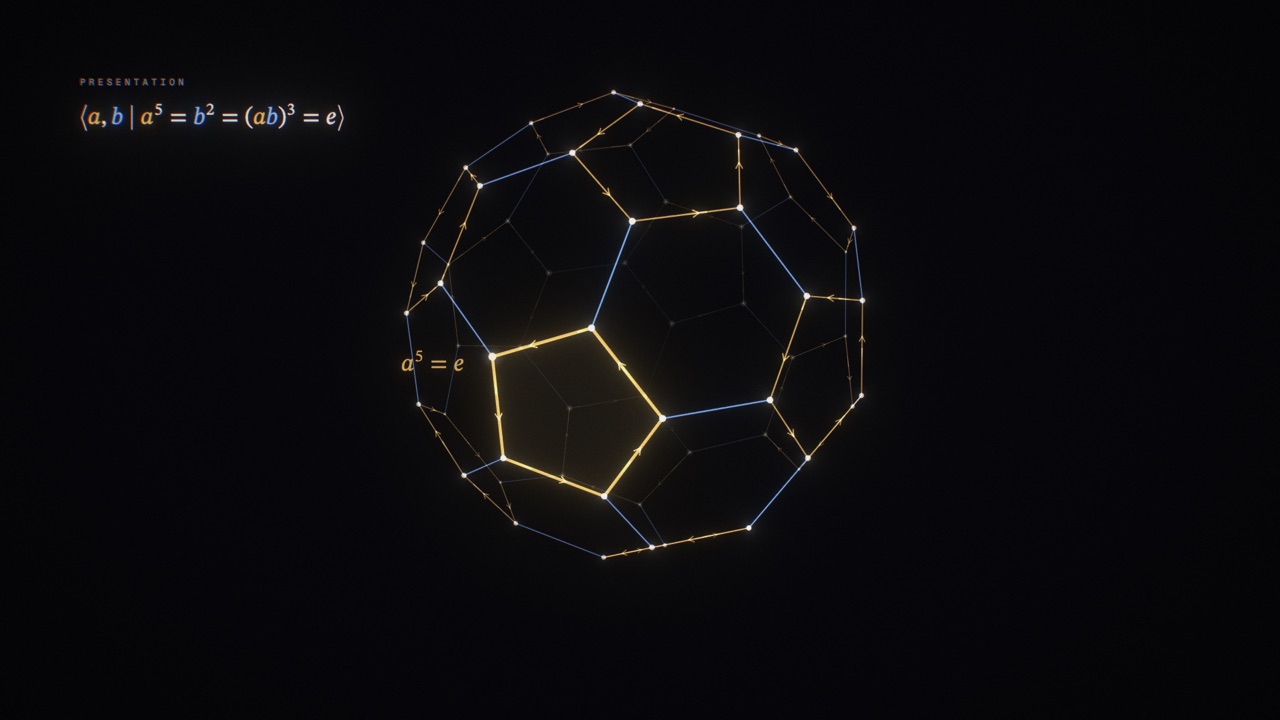 No.00InvariantGroup theoryFilm 6:01
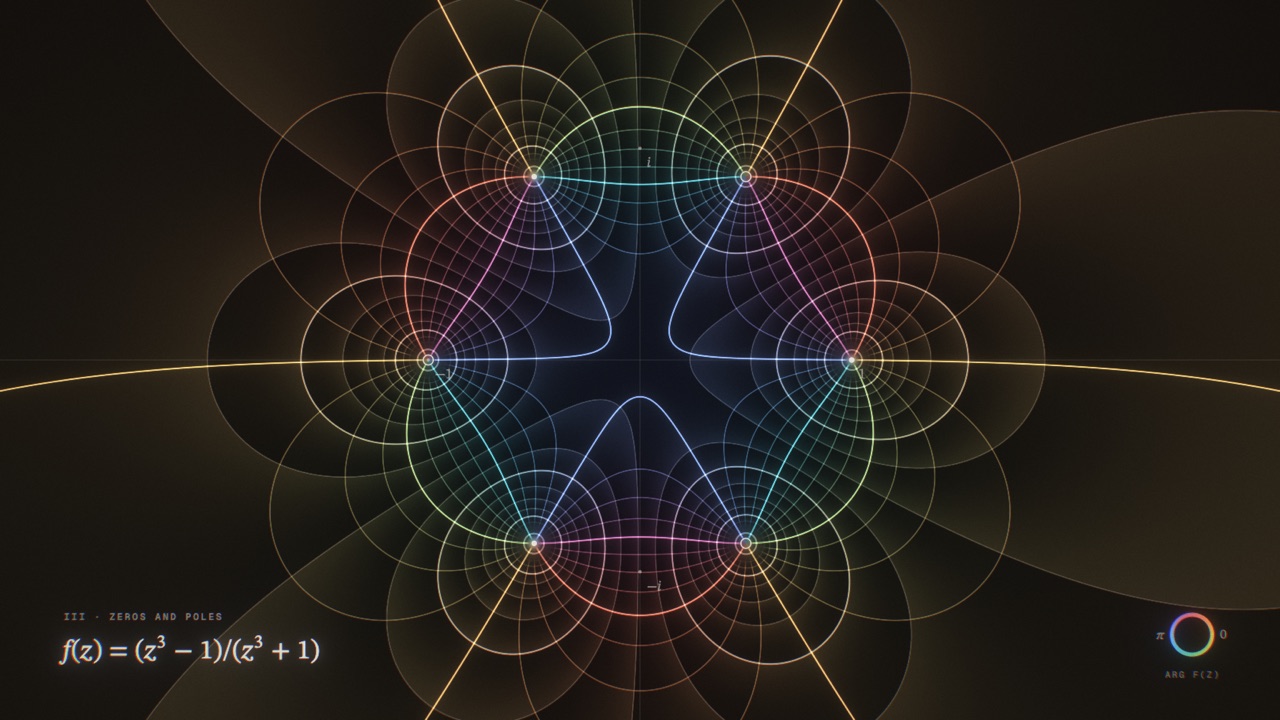 No.01ConformalComplex analysisFilm 9:04 · 5 plates
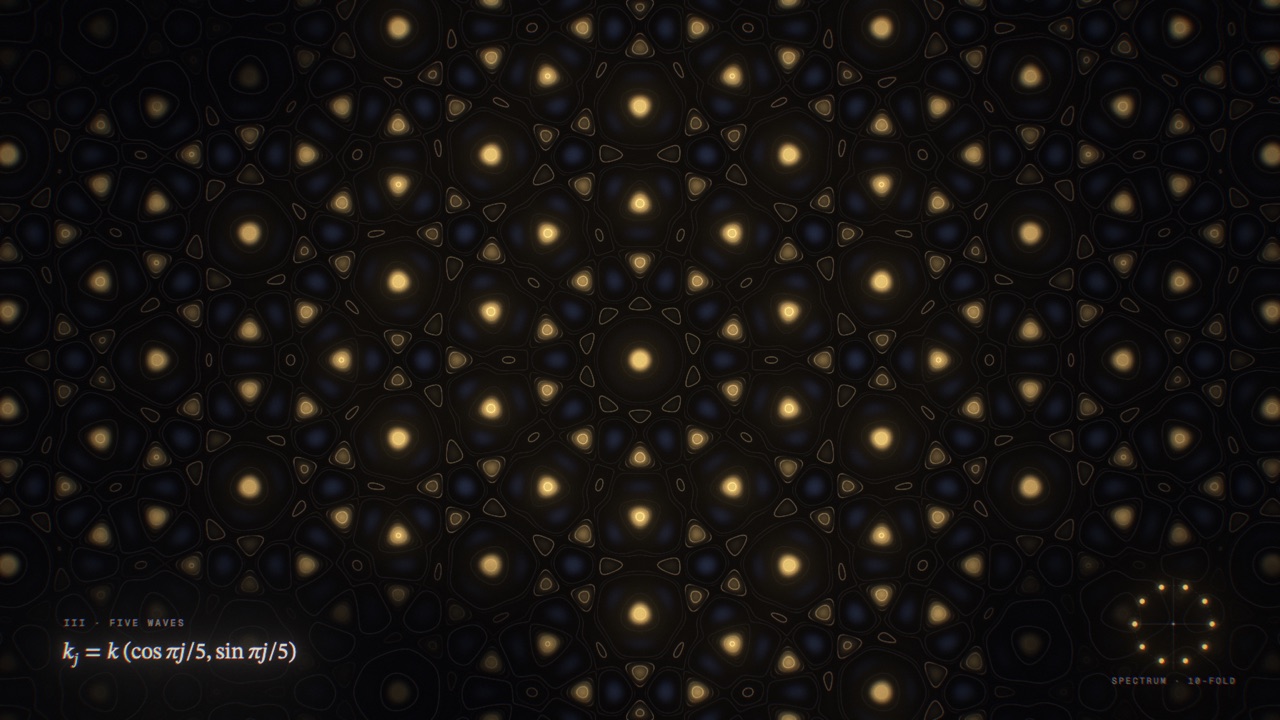 No.02SpectralFourier analysisFilm 9:37 · 5 plates
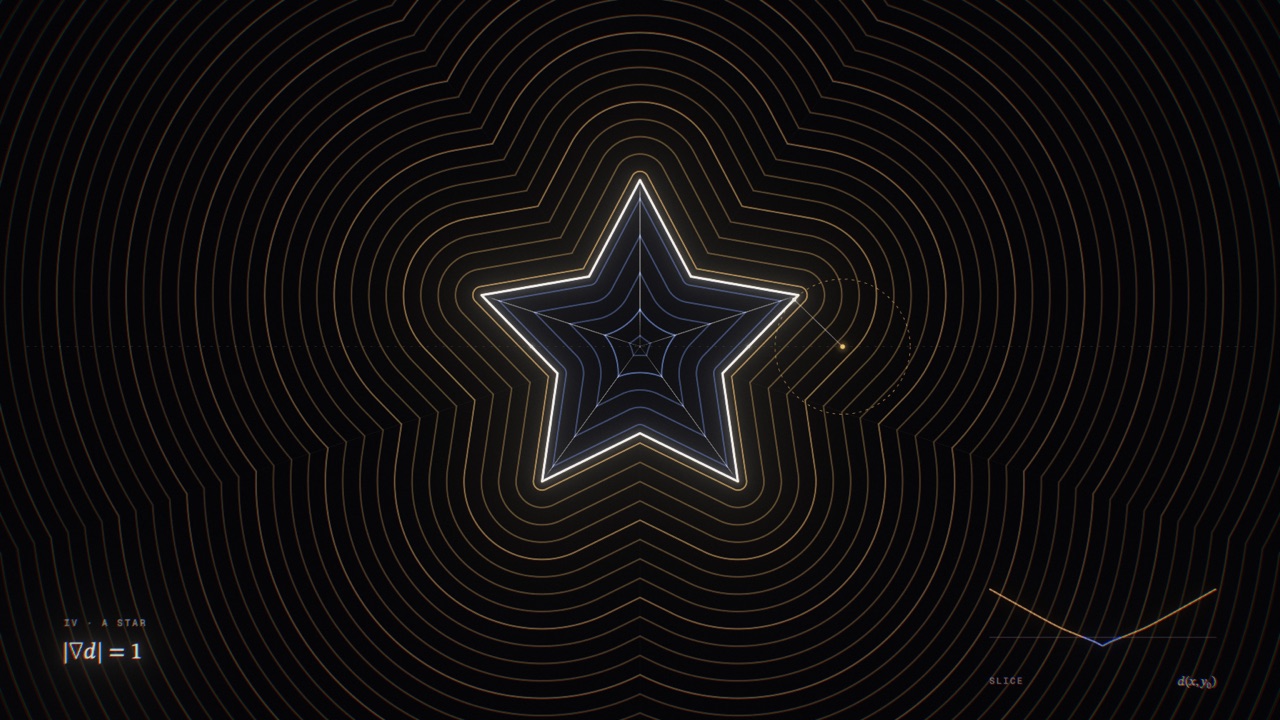 No.03ImplicitSigned distance fieldsFilm 11:47 · 5 plates
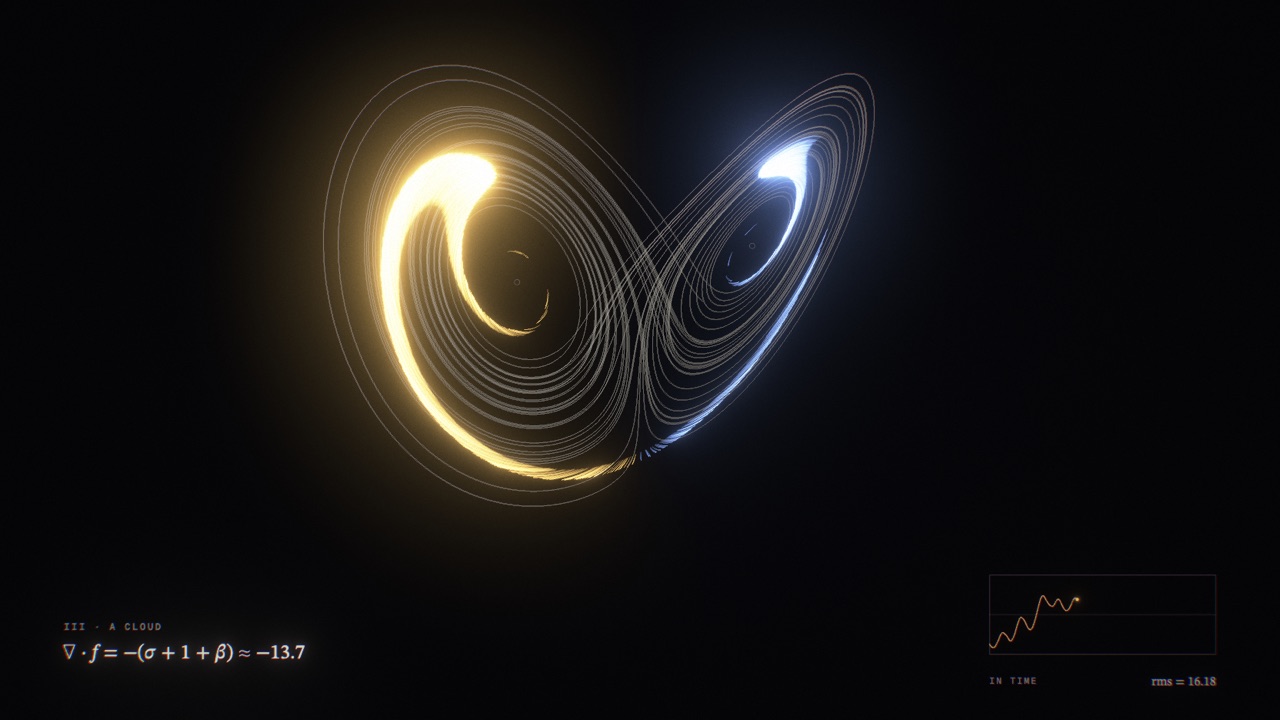 No.04FlowDynamical systemsFilm 15:06 · 5 plates
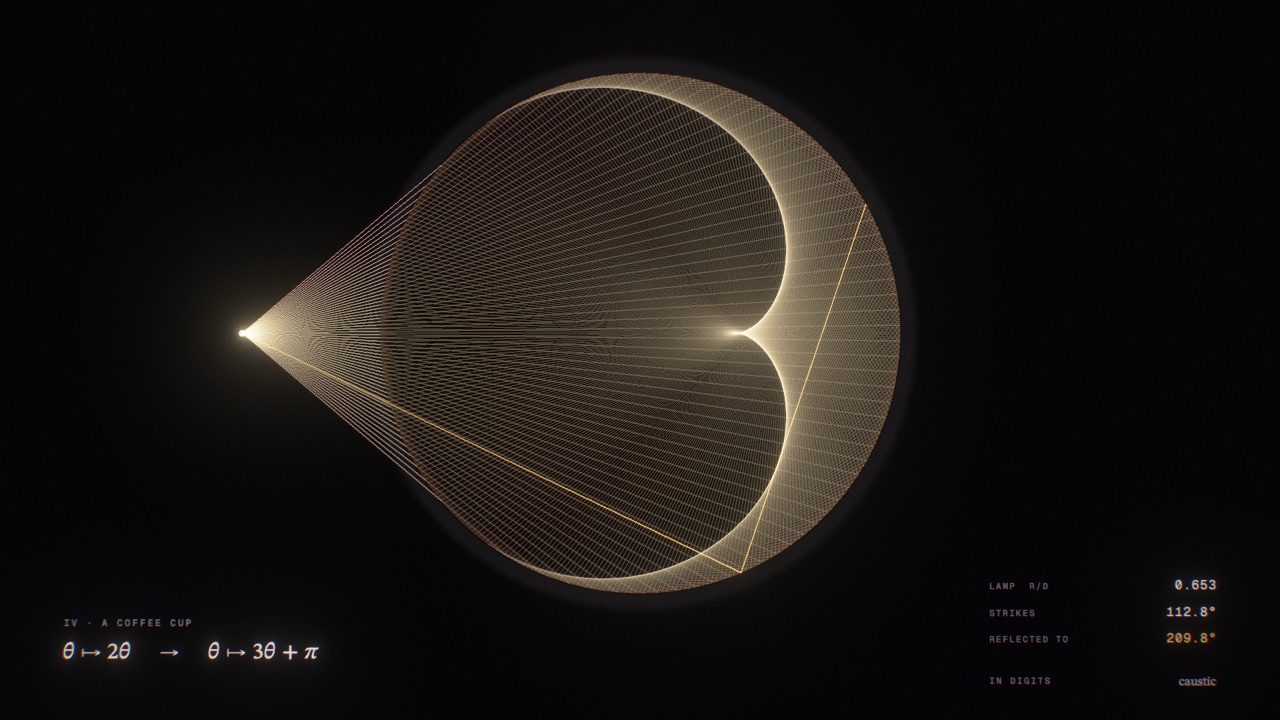 No.05ArithmeticNumber theoryFilm 7:17 · 5 plates
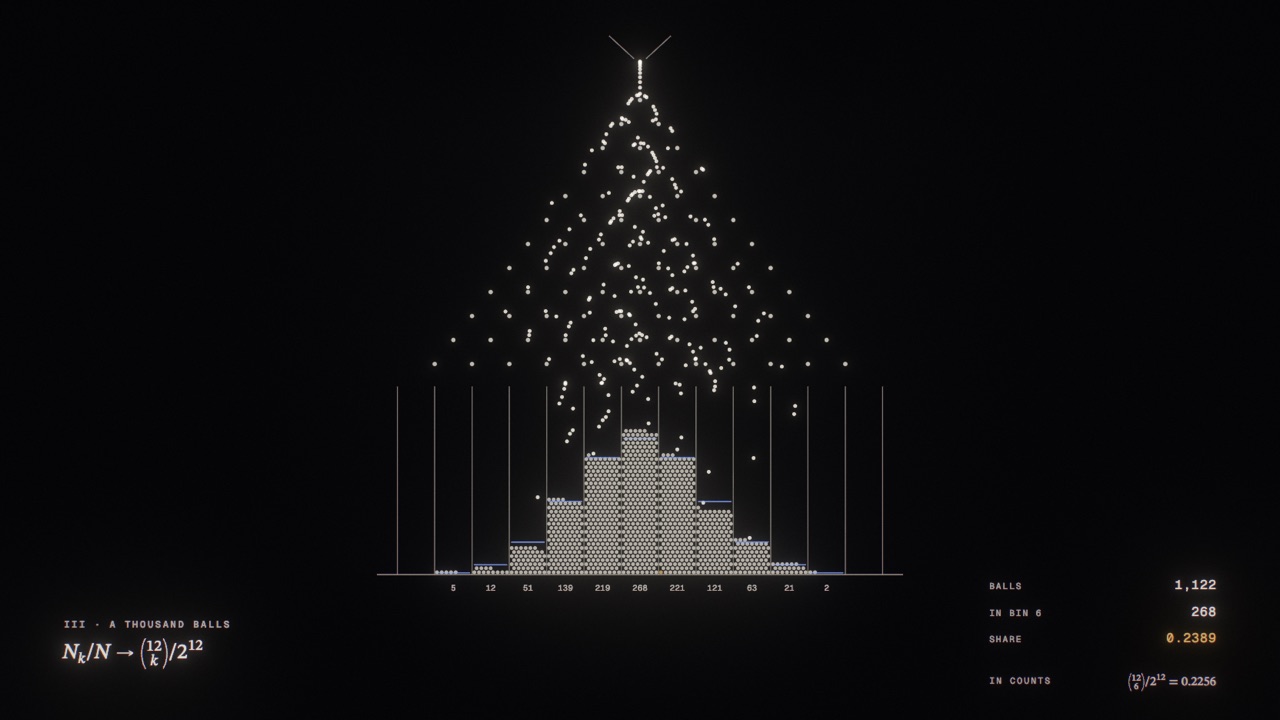 No.06ChanceProbabilityFilm 6:02 · 5 plates
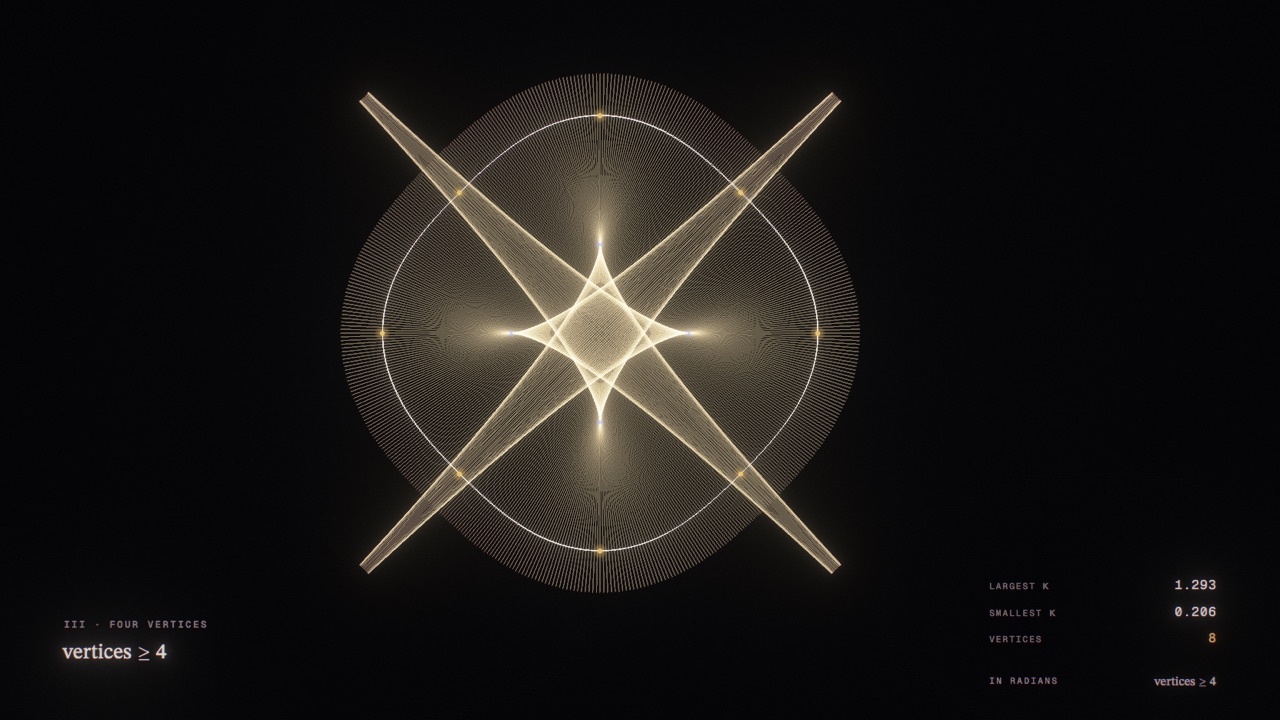 No.07CurvatureDifferential geometryFilm 6:24 · 5 plates
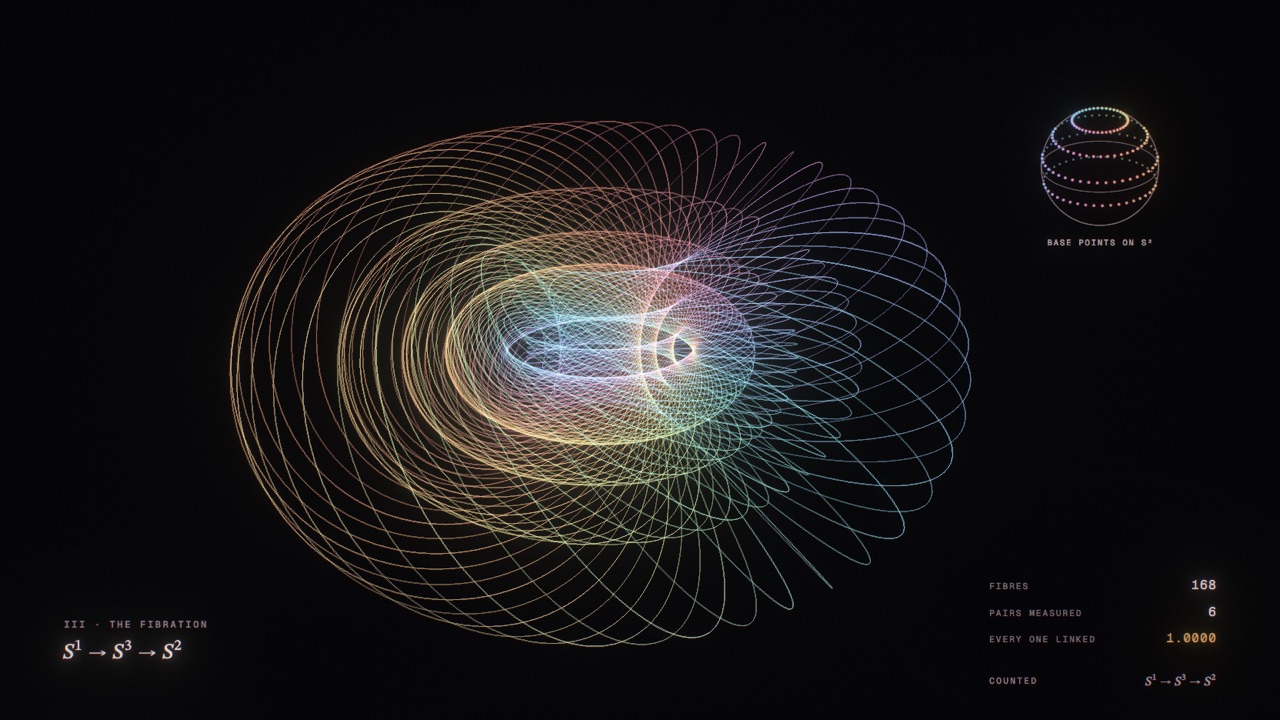 No.08TopologyTopologyFilm 6:42 · 5 plates
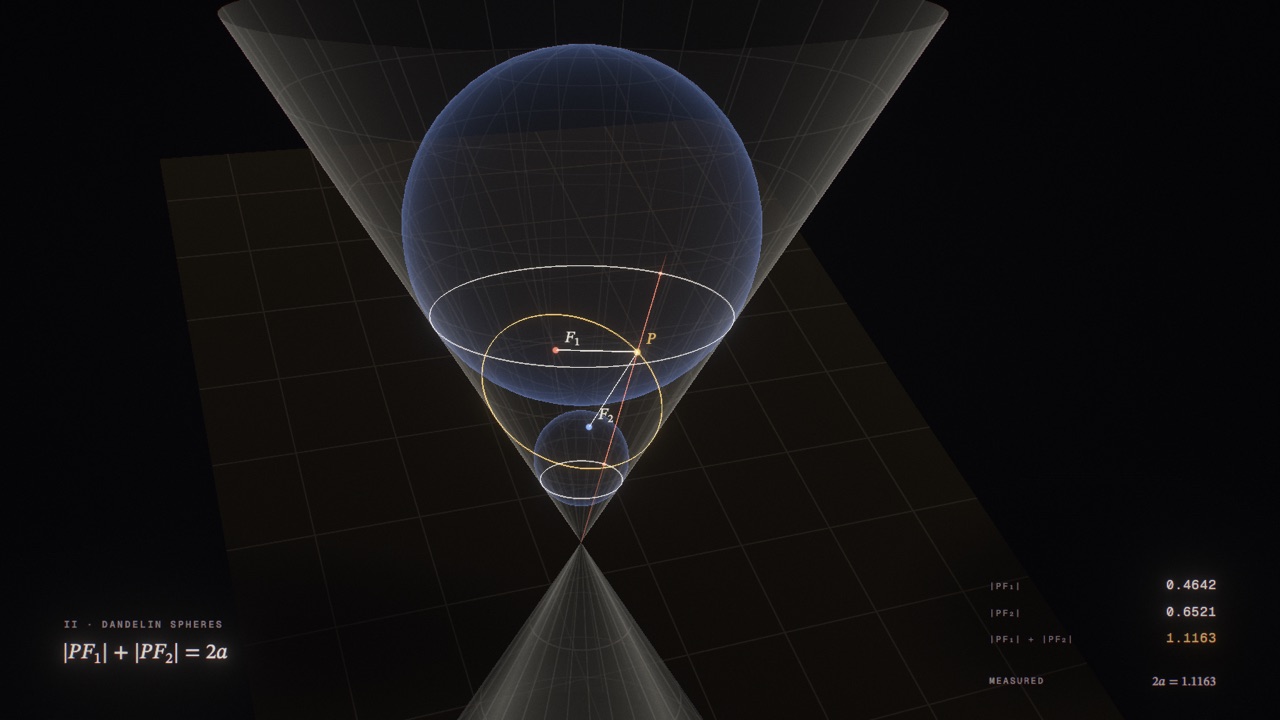 No.09ProjectiveProjective geometryFilm 6:41 · 5 plates
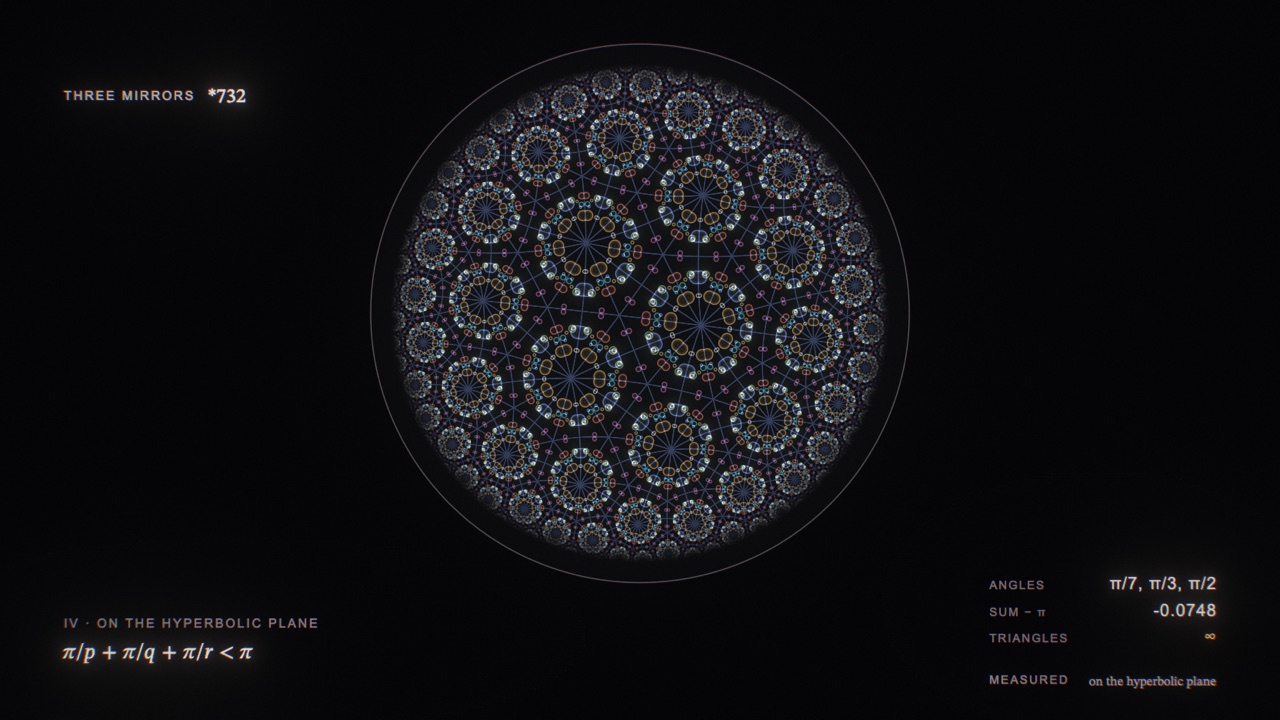 No.10SymmetrySymmetry in the plane and in spaceFilm 6:49 · 5 plates
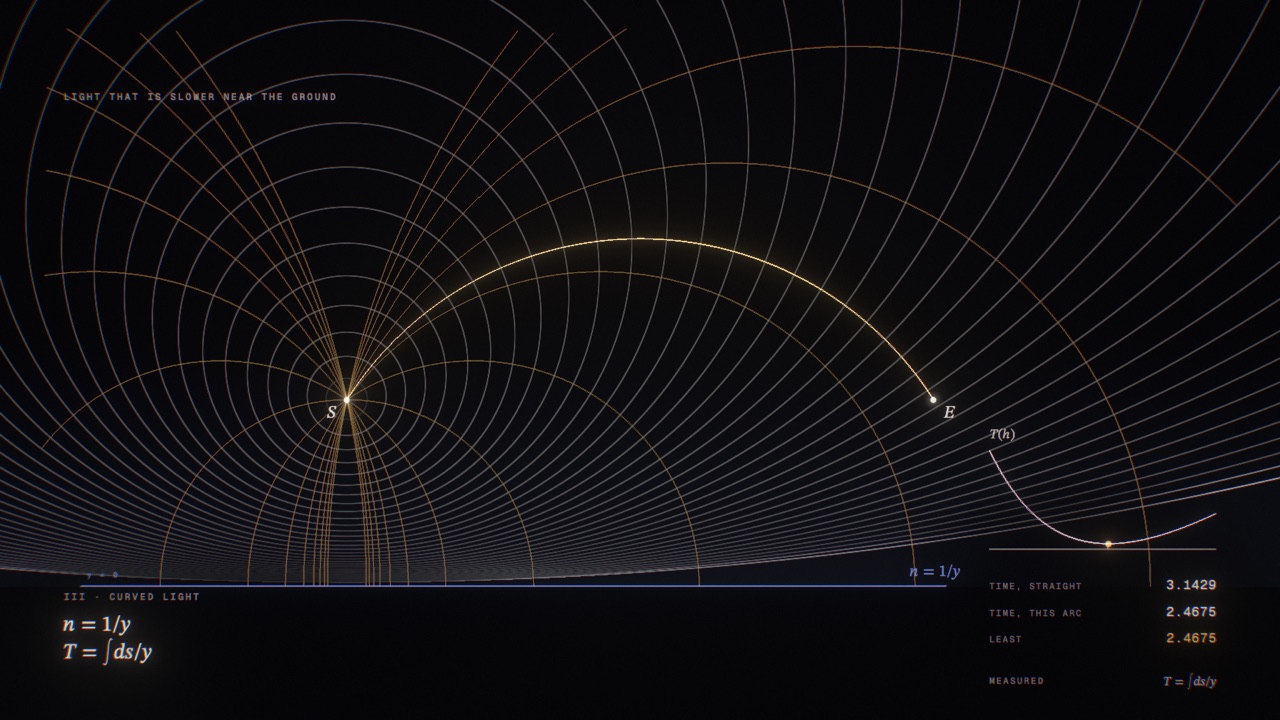 No.11VariationalCalculus of variationsFilm 6:59 · 5 plates
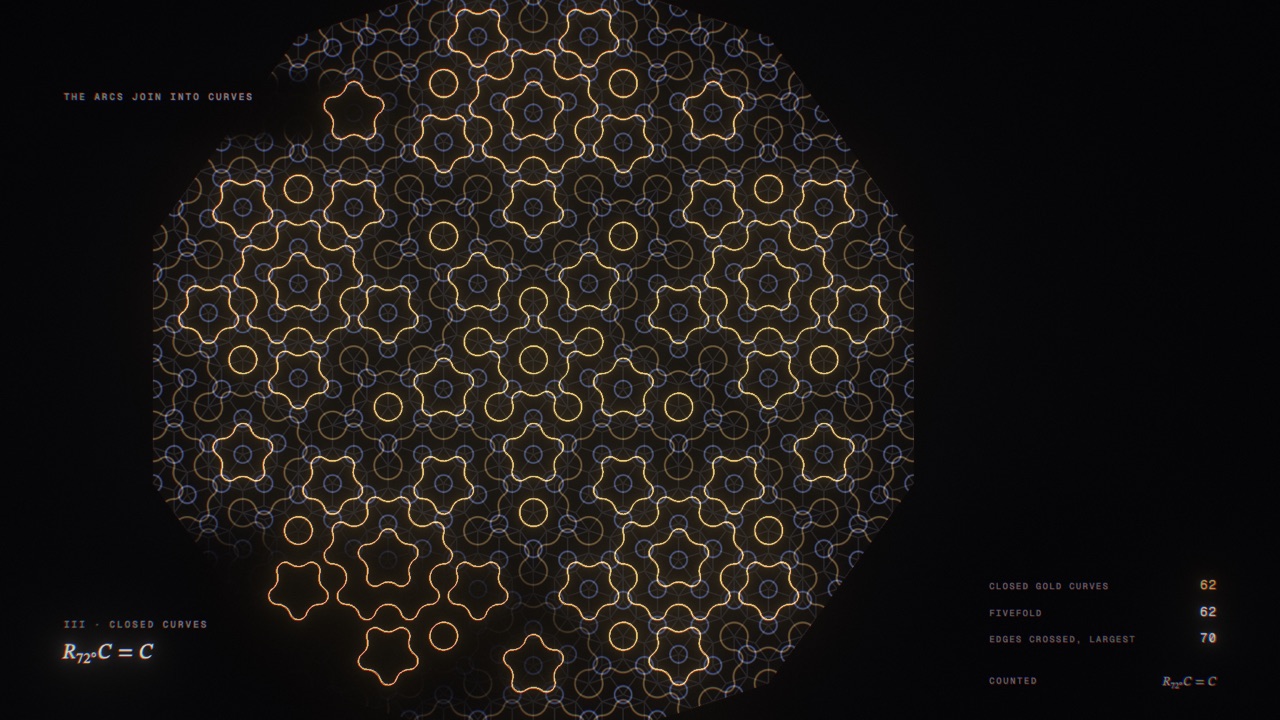 No.12AperiodicAperiodic tilingsFilm 6:53 · 5 plates
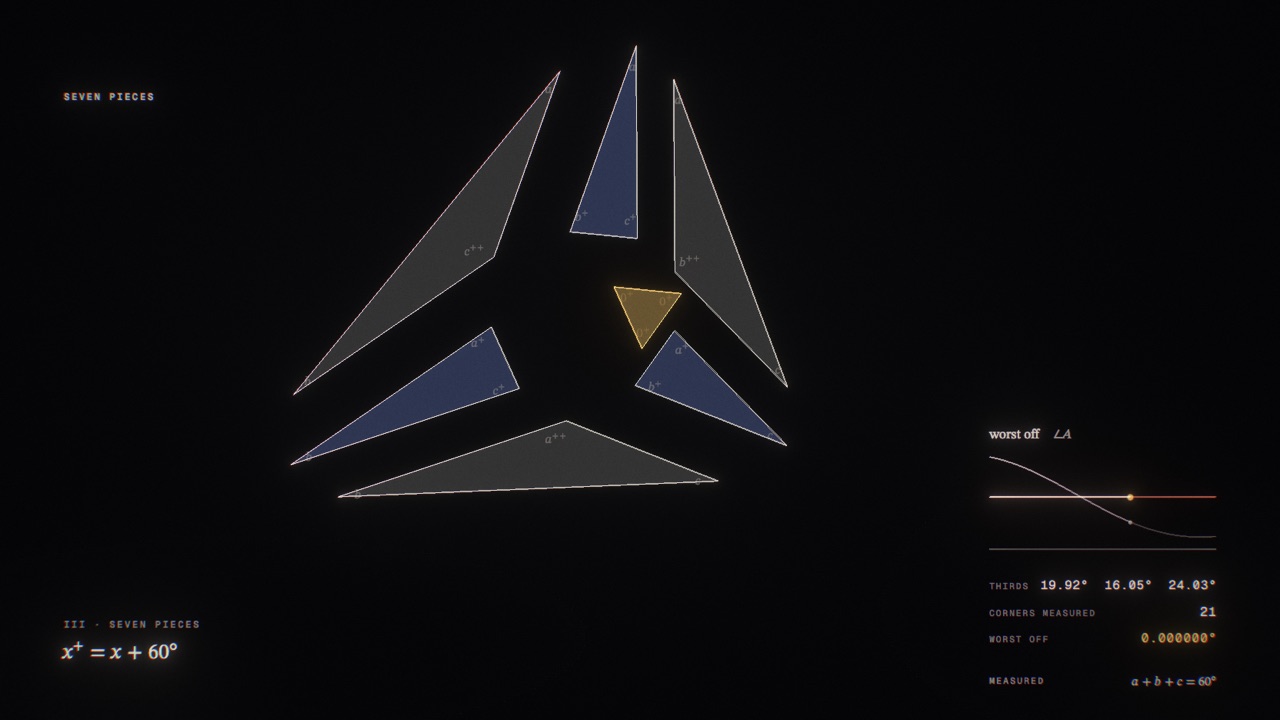 No.13EuclideanTriangle geometryFilm 7:28 · 5 plates
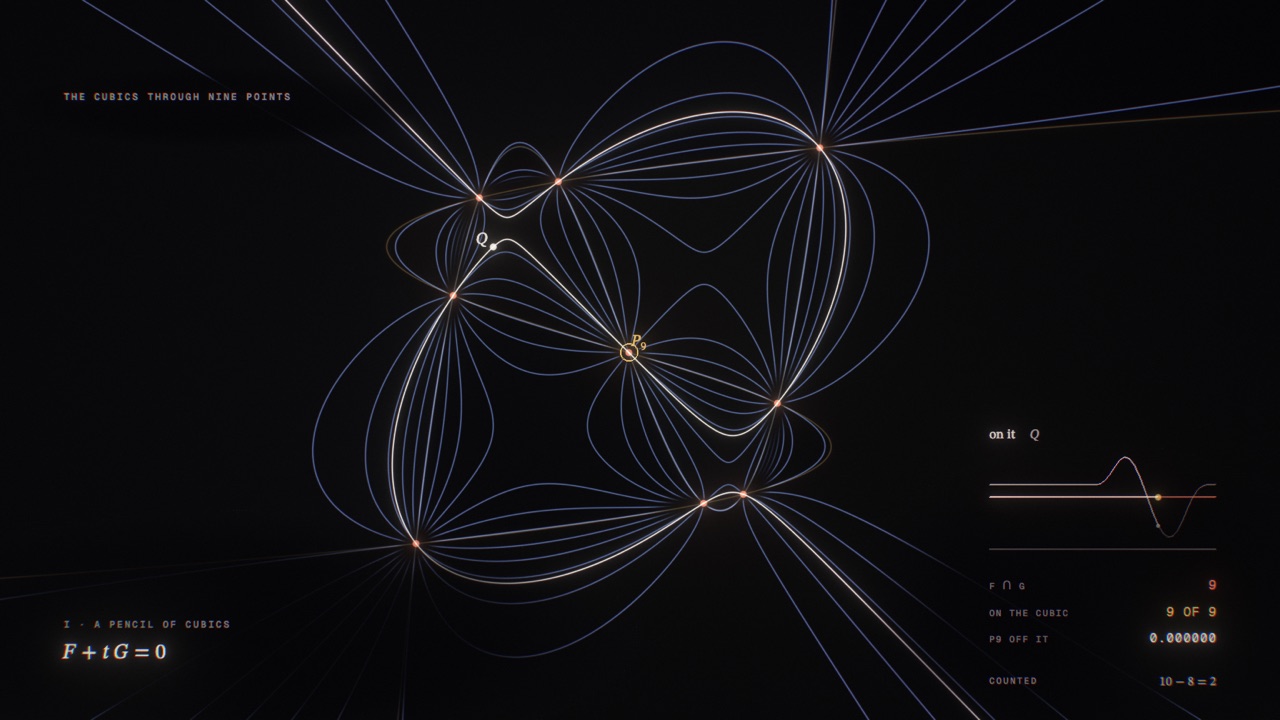 No.14AlgebraicAlgebraic curves and surfacesFilm 6:55 · 5 plates
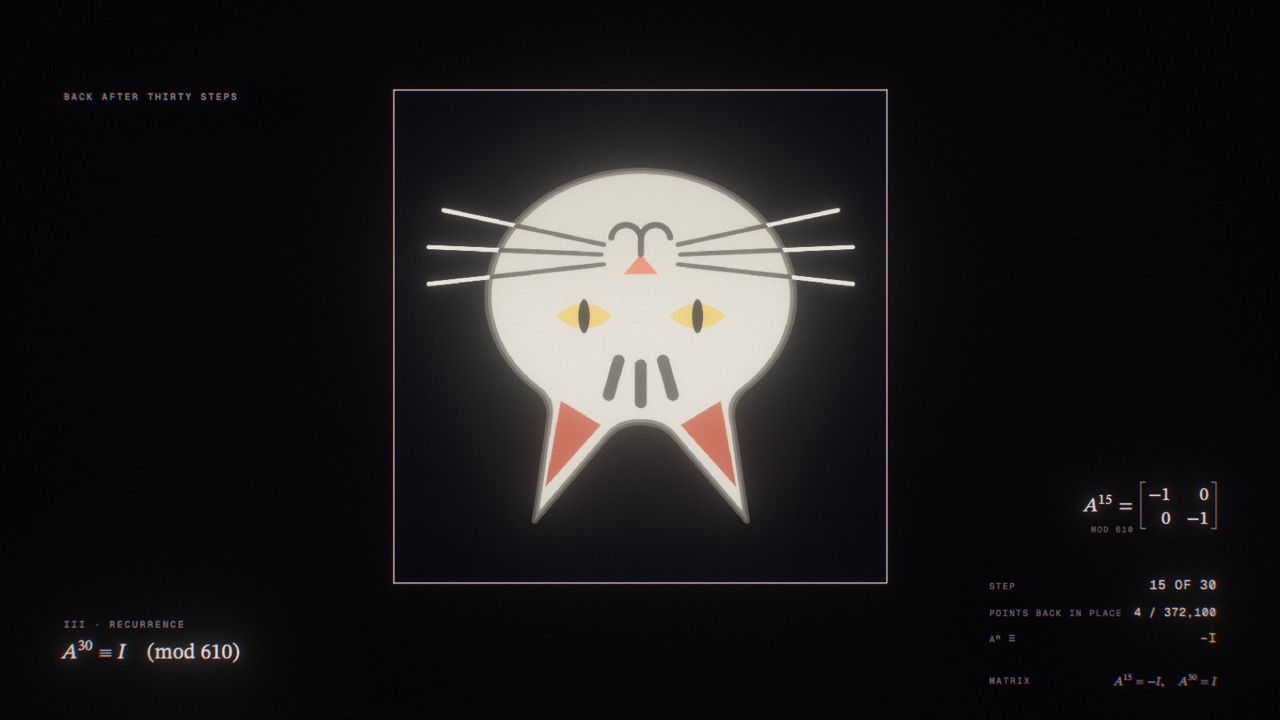 No.15LinearLinear algebraFilm 7:01 · 5 plates
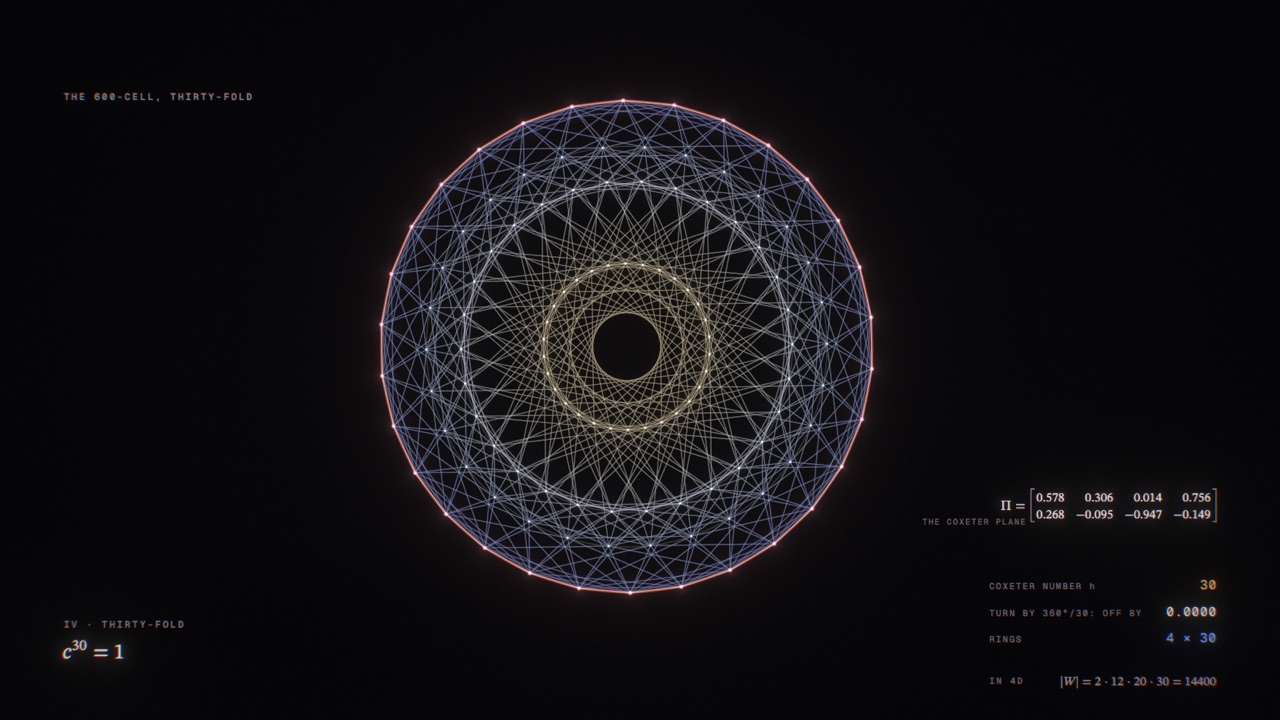 No.16PolytopesRegular polytopes in four dimensionsFilm 6:43 · 5 plates
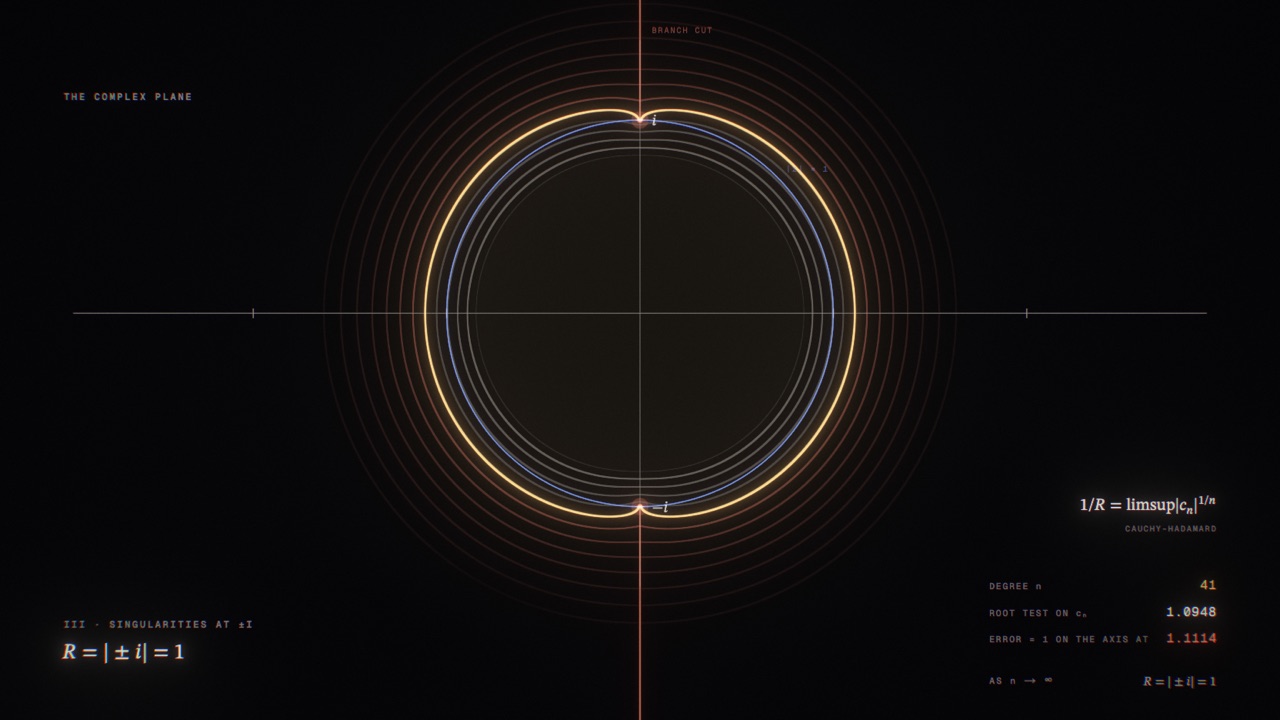 No.17ApproximationApproximation of functionsFilm 6:57 · 5 plates
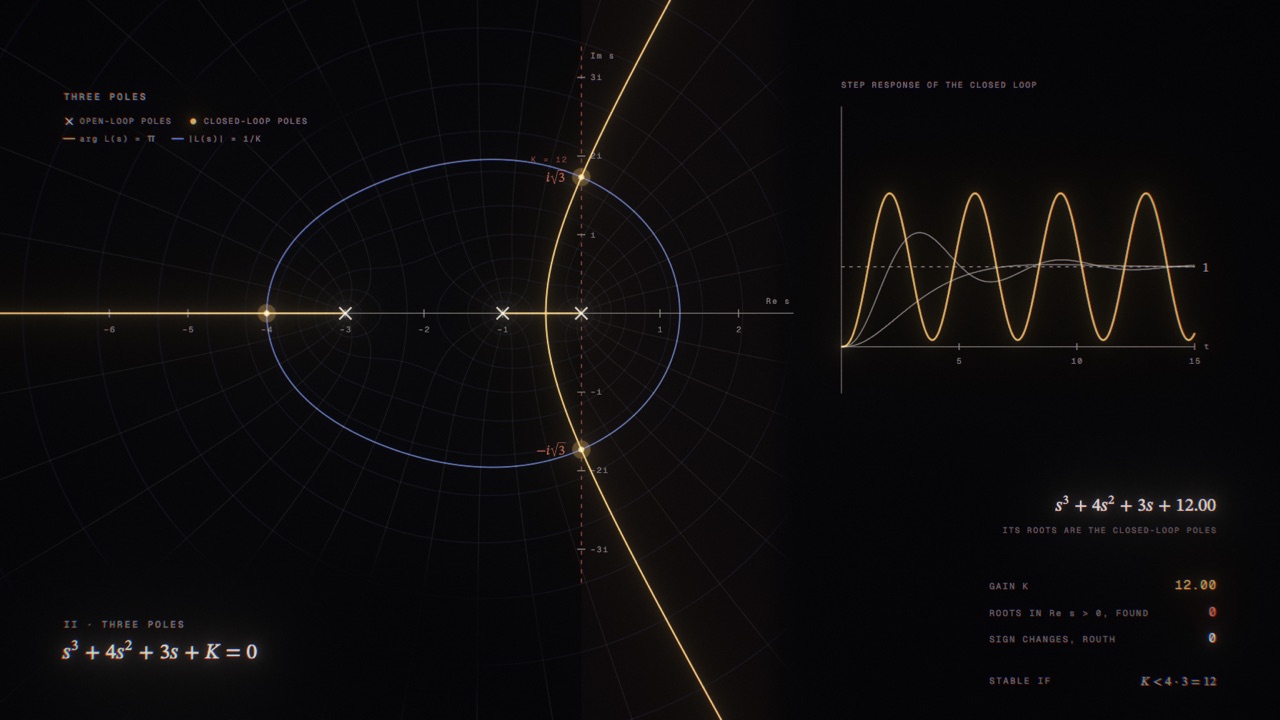 No.18FeedbackFeedback controlFilm 7:29 · 5 plates
- No.19NoncommutativeNoncommutative geometryFilm 9:13 · 5 plates
Studio
Some things become clear only once you handle them: adjust a parameter, drag a shape, and watch the structure change. The Studio holds tools like that, with more to come.
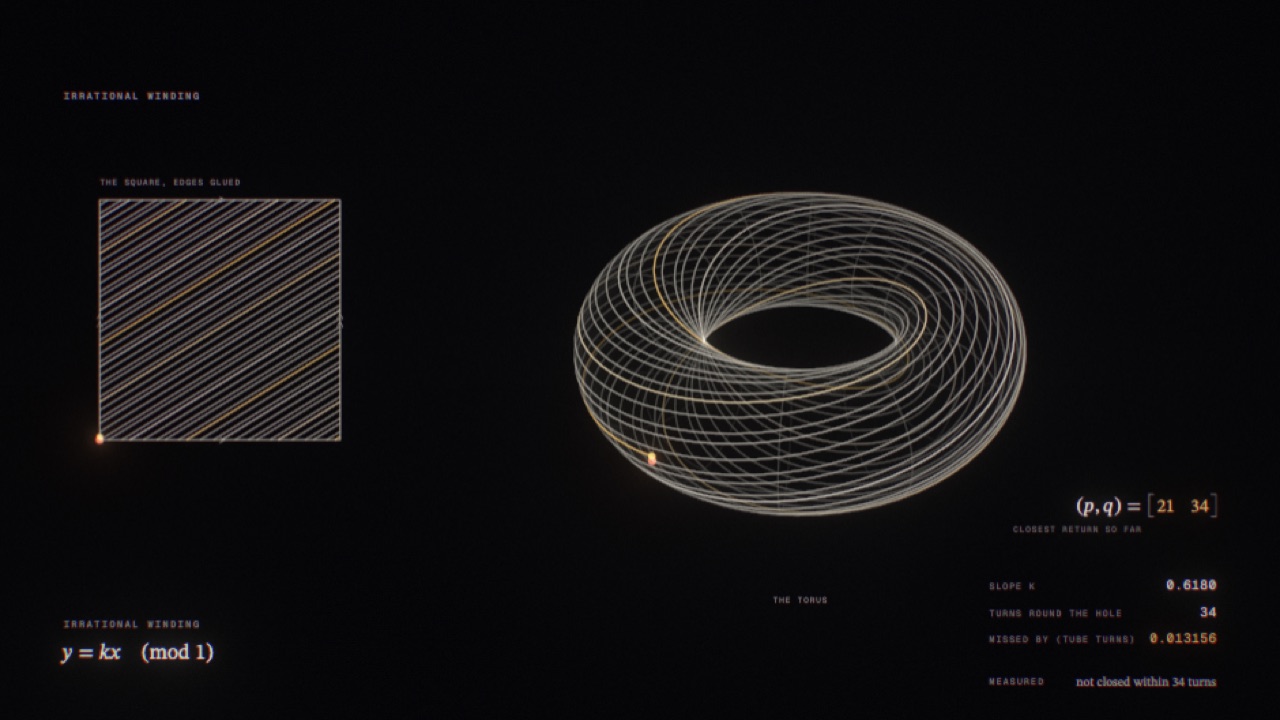 From NoncommutativeA slope just offMove the slope just a little: does the line still close?Open →
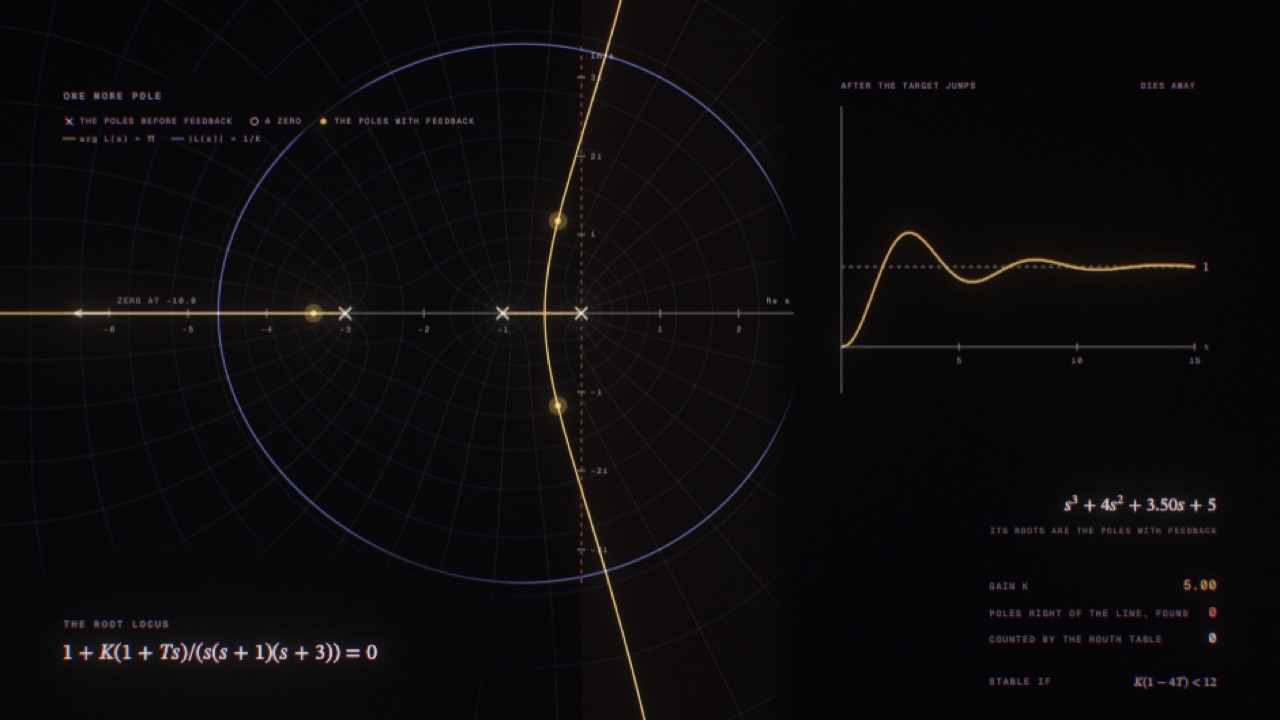 From FeedbackThe root locusTurn up the gain K: where do the poles go?Open →
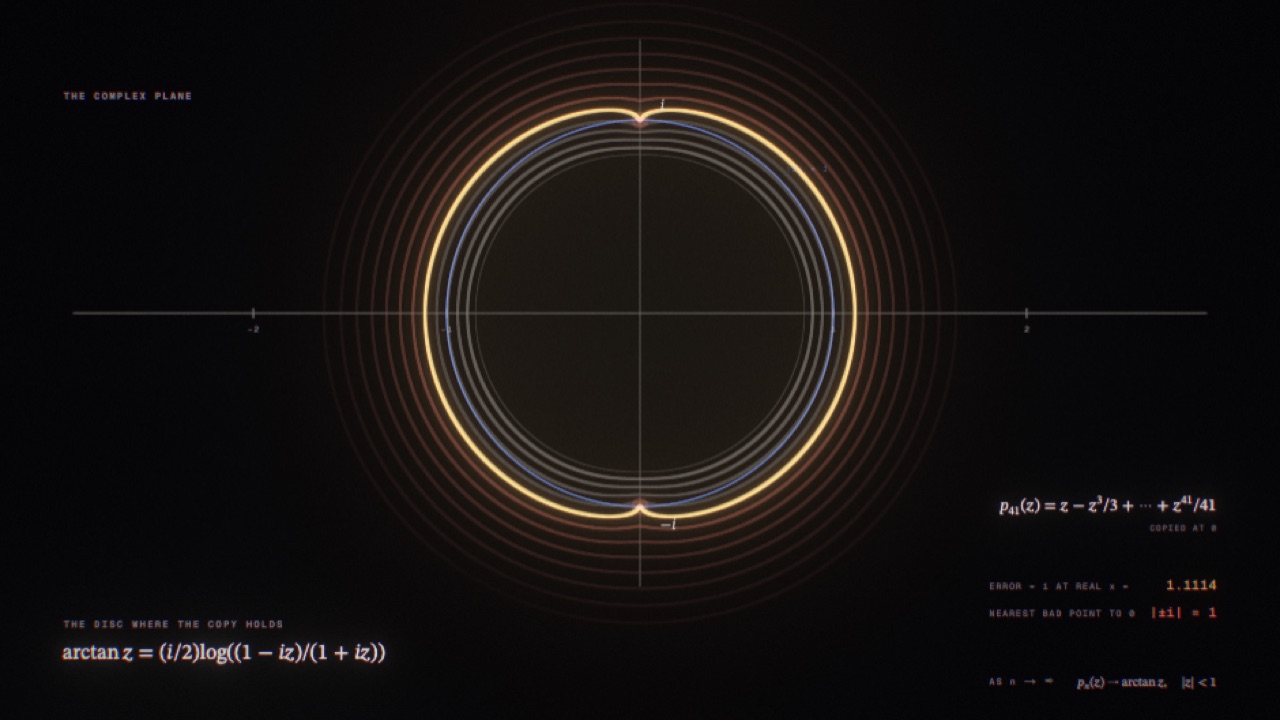 From ApproximationA series hits a wallCopy a curve at one point, term by term: how far out does the copy hold?Open →
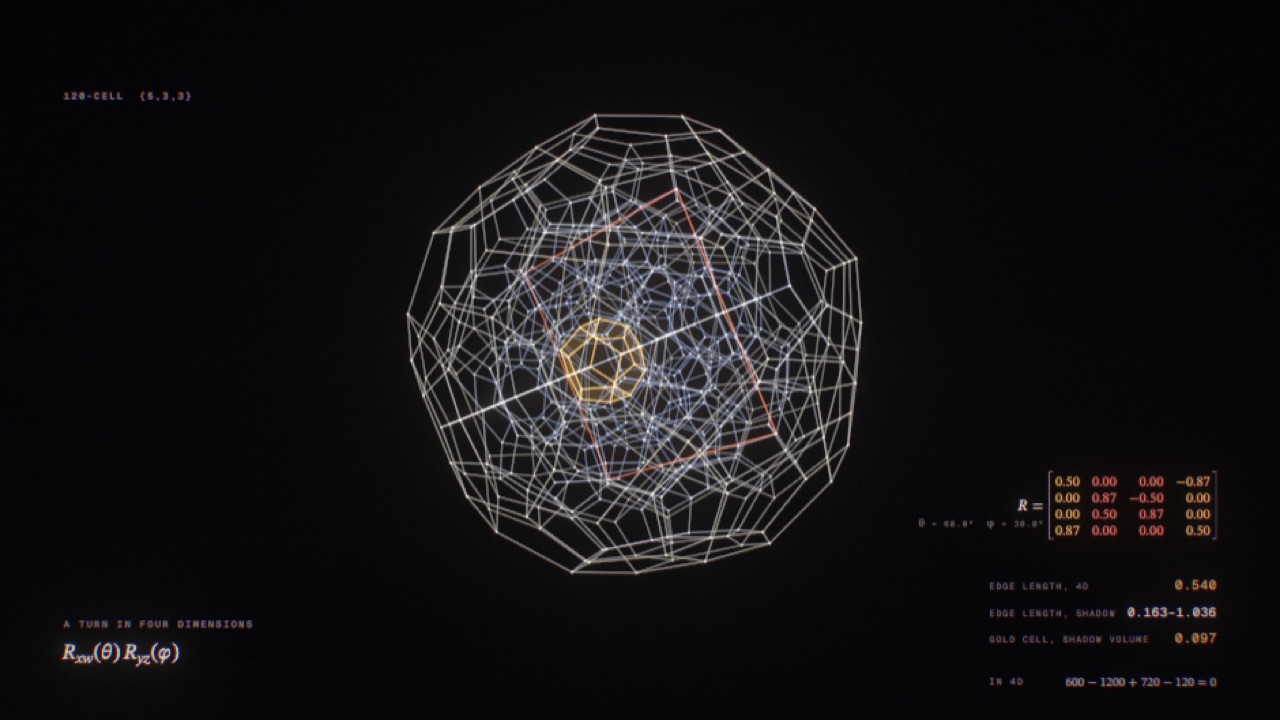 From PolytopesTurning in four dimensionsTurn it in four dimensions: the shadow changes, so what stays the same?Open →
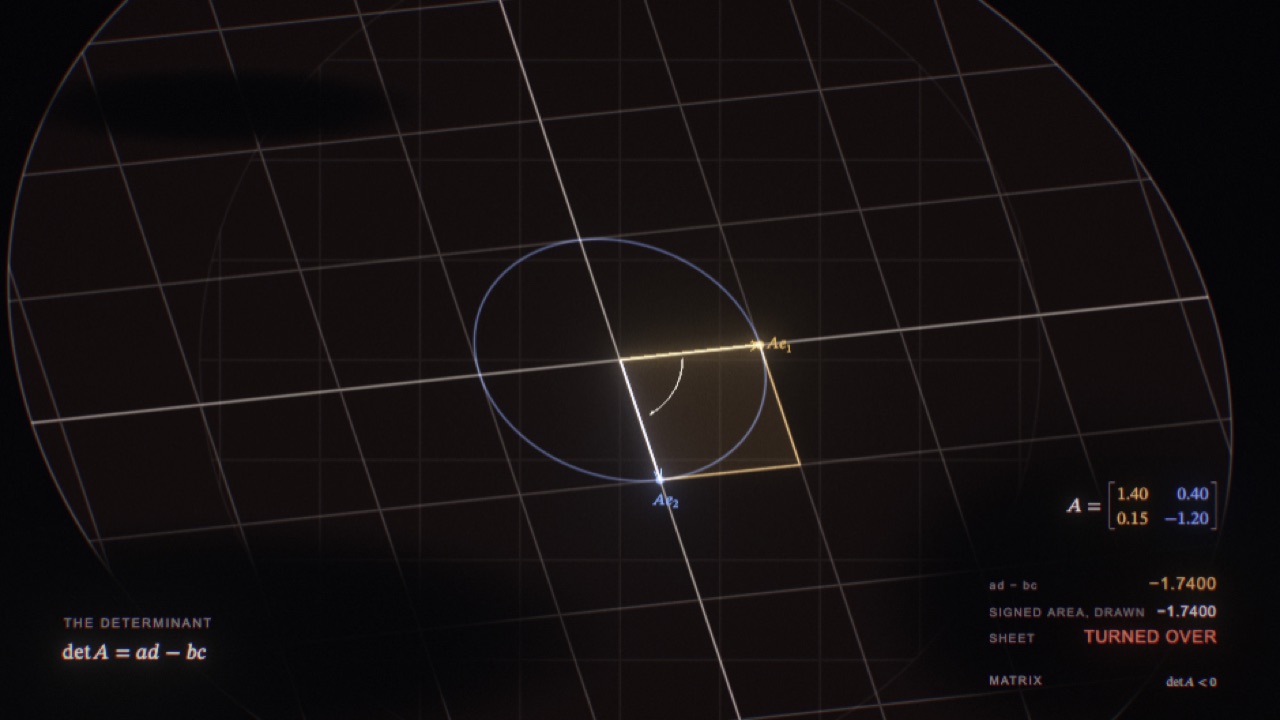 From LinearThe whole sheet at onceWhere must the two columns go for the whole sheet to be pressed onto a line, or turned over?Open →
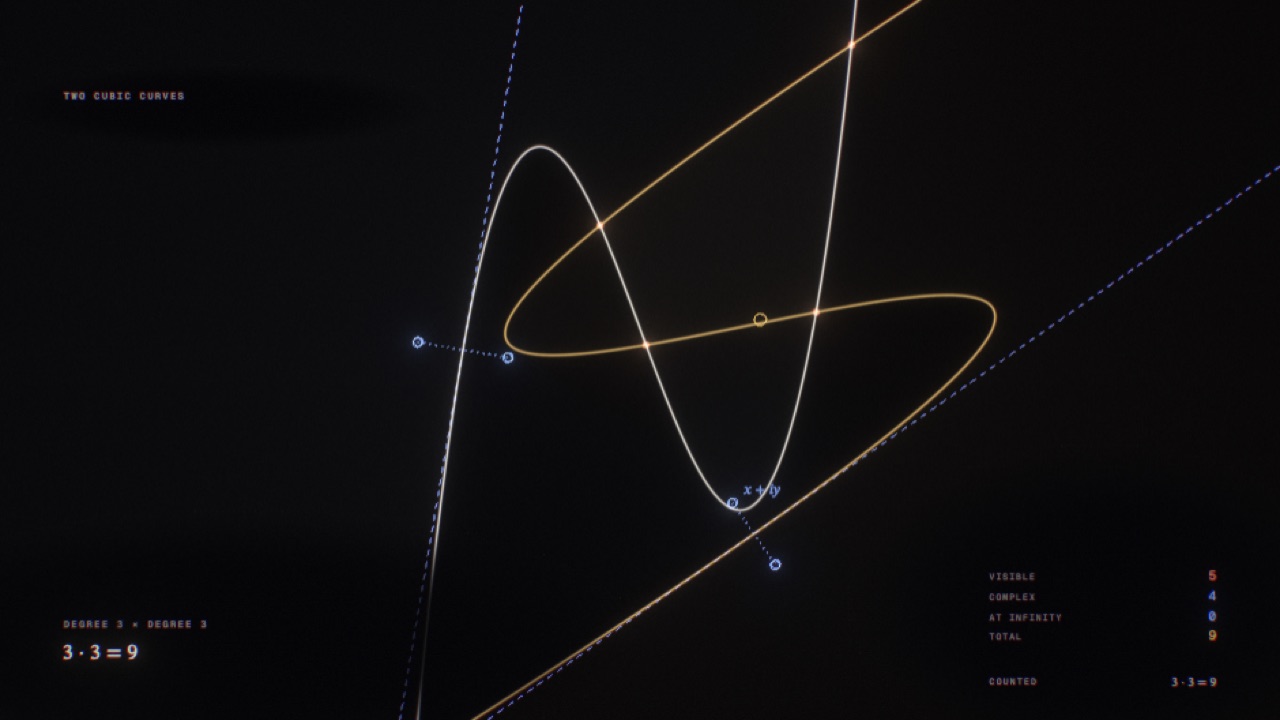 From AlgebraicWhere two curves meetThe intersections you can see come and go: how many are there altogether?Open →
How it is made
Each language version is written in that language, not translated from another: the lines follow what each moment has to say, and the pictures are timed to the narration. The same code draws the film here, the videos on each platform, and the tools in the Studio.