I Distance
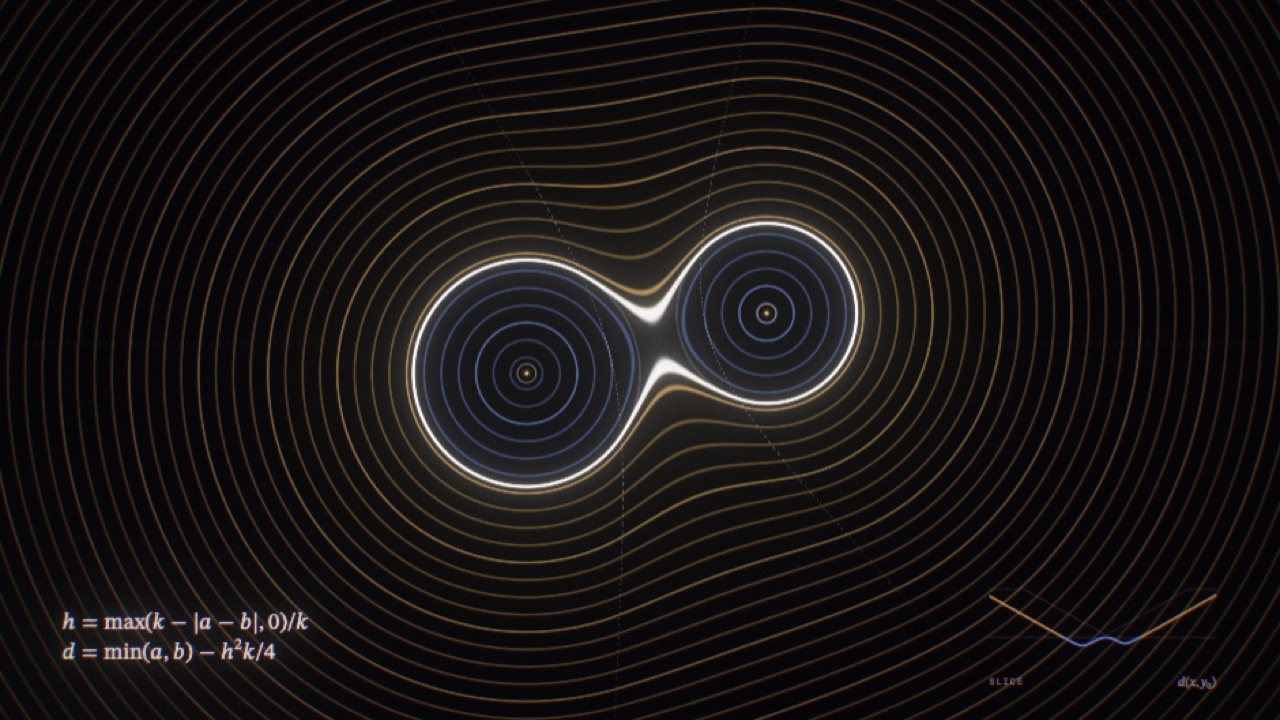
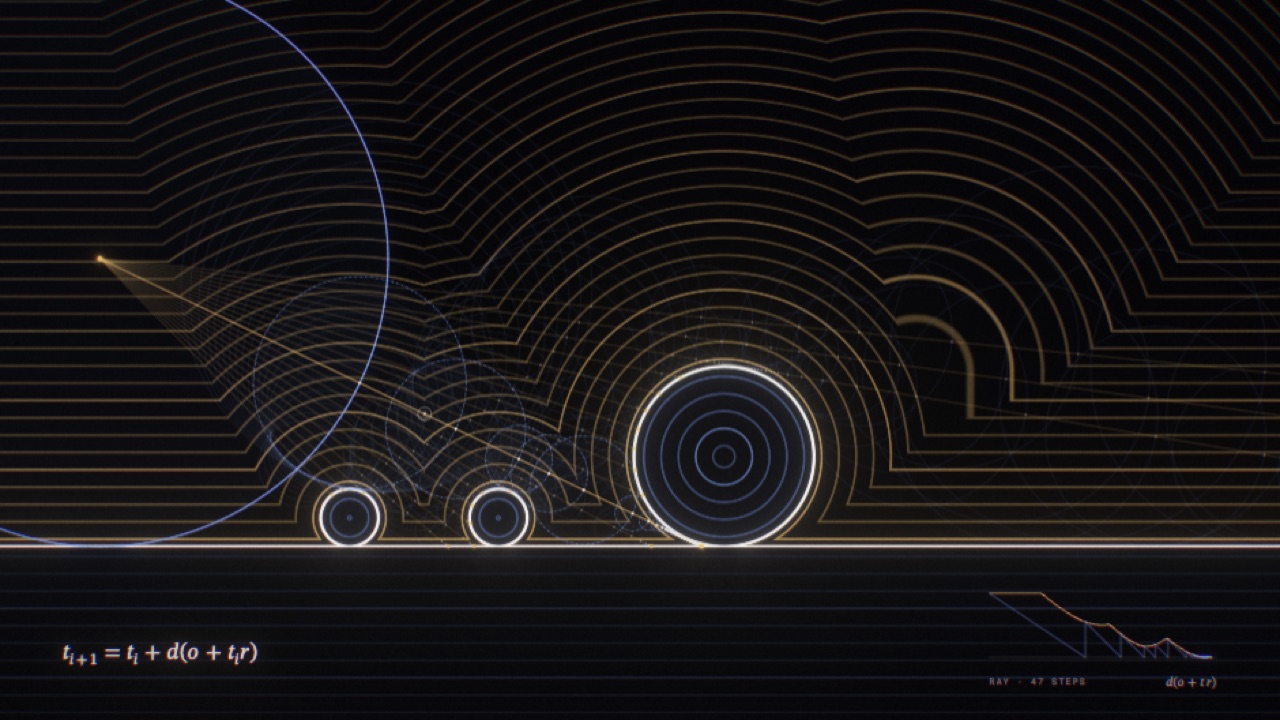
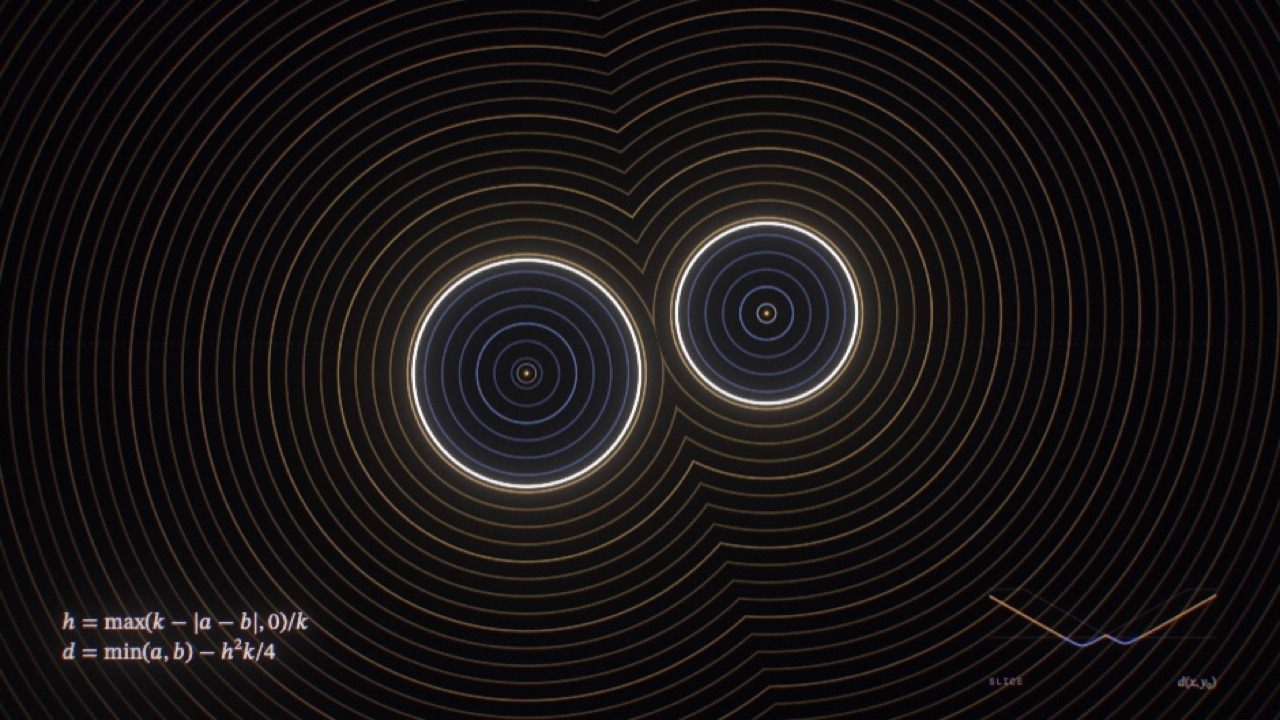
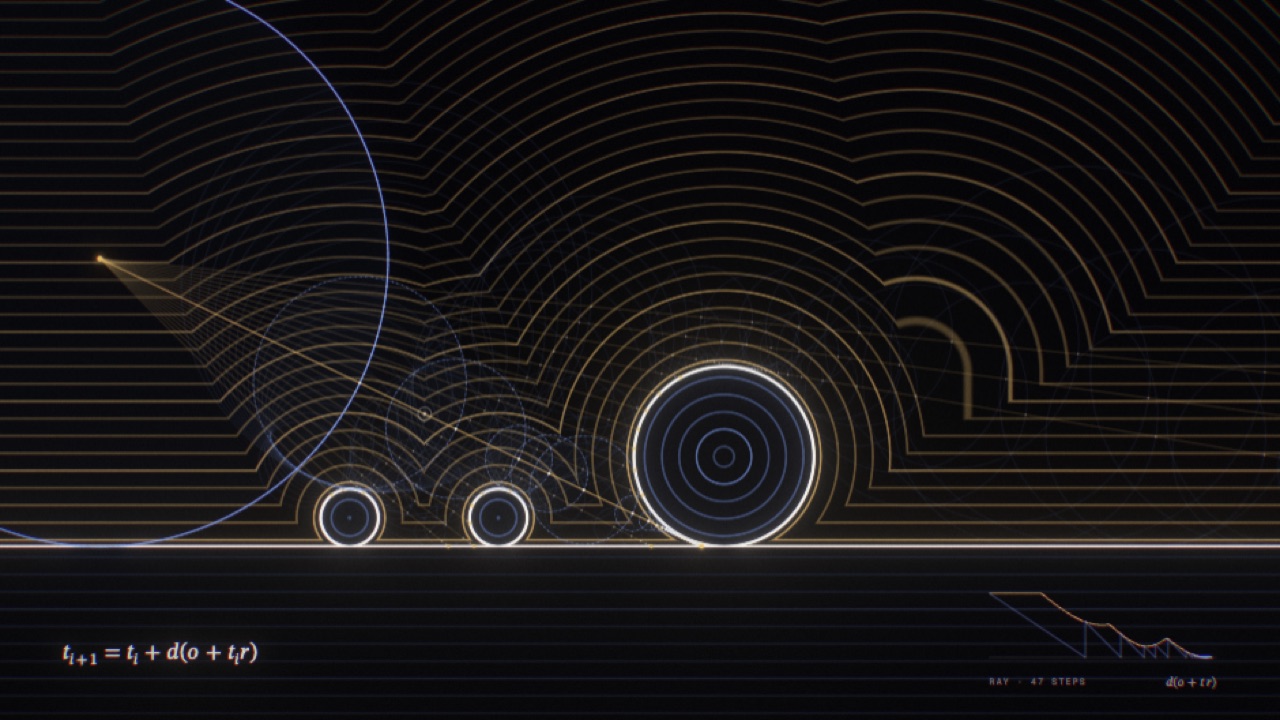
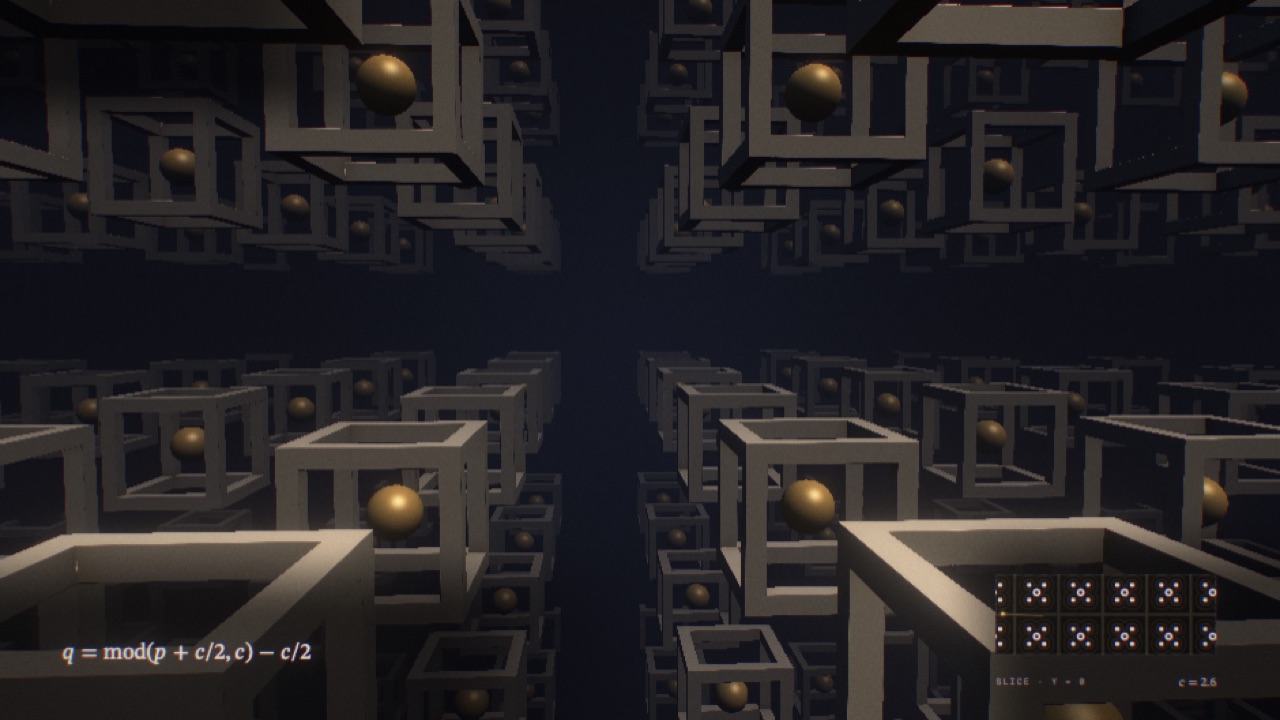
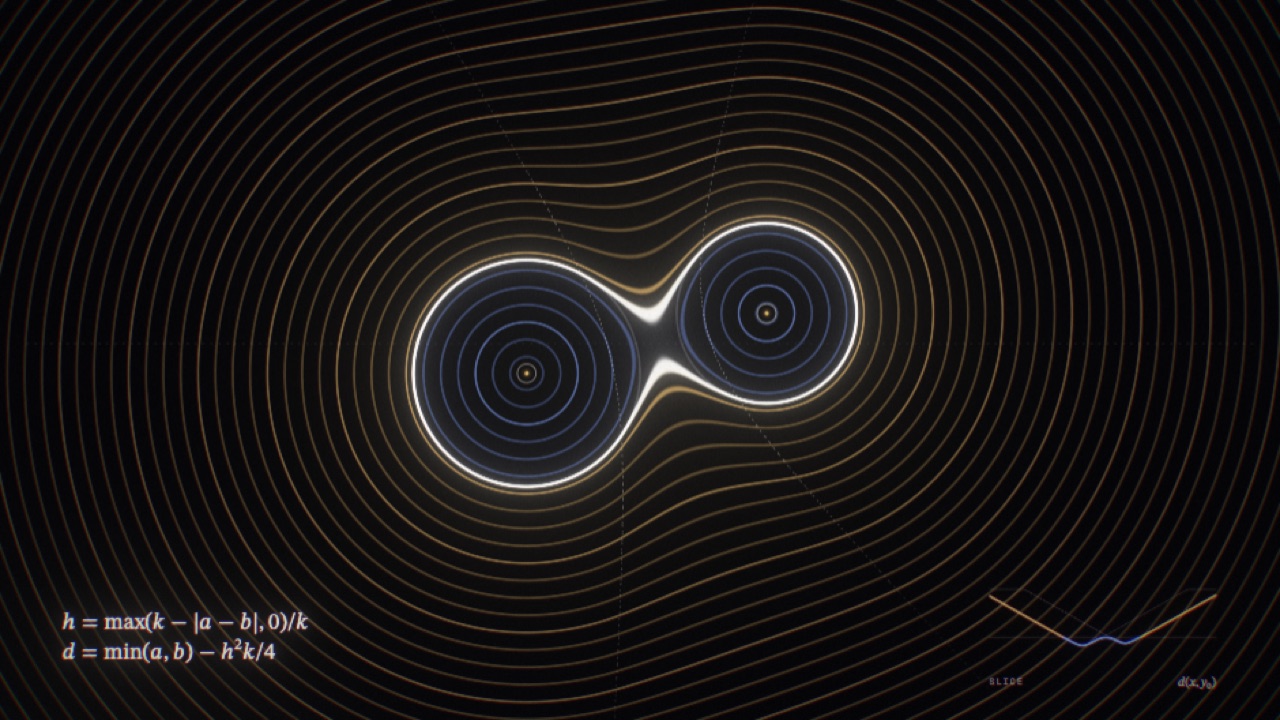
A signed distance field gives every point its distance to a shape, positive outside and negative inside; the shape is where the field is zero. Its level sets, gold outside and ice-blue inside, are the fronts of the shape: everything exactly so far from it. They drift outwards here, welling up from the skeleton and crossing the boundary. The dashed line is a slice, and the corner plots the field along it.
- A circle
- d(p)=|p|−rThe distance to a circle. Every level set is a circle too, spaced exactly as their values say: move one pixel along a radius and an exact distance field changes by exactly one pixel; away from the centre, |∇d|=1.
- Corners
- q=|p|−bd=|max(q,0)|+min(max(qx,qy),0)−rThe circle grows into a rounded box. Outside, the fronts round every corner off; inside, once they are deeper than the corner's radius, they turn sharp, and the corners run in along the corner bisectors, where each point is equally near two edges. Those bisectors, with the segment that joins them, are the skeleton.
- Fronts
- {p:d(p)=c}Move the bright front inwards, c falling below zero: the rounded corners shrink and turn sharp, the fronts meet along the skeleton, and the box burns out last along its middle segment (Blum's grassfire). Then a star grows out of its own deepest point.
- A star
- |∇d|=1A star is not convex, so its skeleton reaches outside as well, into every concave corner. The probe carries the largest circle around it with no boundary inside; its radius is |d|, and where it touches the boundary are the nearest points. Where the gradient exists there is just one, p−d∇d; on the skeleton there are more. At the end the star burns out and the circle grows back.