yAtlas

Drawing the first frame…

0:00 / 15:06Prologue

The Order Beneath · No.04 · Rendered in real time · 15:06

Flow

A short film about flows

Dynamical systems in six short chapters: how, without solving the equations, the shape of the arrows alone tells whether motion settles to a point, winds onto a loop or never repeats on a strange attractor; and why rules with nothing random in them still put the far future out of reach once the start is known only to a few decimal places. Every frame is computed by code; on the website, each one is drawn live in your browser as the film plays.

Runtime
15:06
Chapters
Six, with a prologue and a coda
Resolution
Matches the player, up to 4.4 MP
Frame rate
Up to your display’s refresh rate, depending on the device
Prerecorded frames
None
Languages
中文 · English

Try it yourself

Each of these moments in the film opens in the Studio, where you can try the idea yourself.

  1. Drag the point across the parabola and watch the spiral become a nodeII · Near a fixed point
  2. Visit every region of the trace–determinant planeII · Near a fixed point
  3. Release orbits inside and outside the loopIII · A loop of its own choosing
  4. Drag μ back to 0, then up again, and watch x(t) square offIII · A loop of its own choosing
  5. Release an orbit between two wallsIV · The kicked pendulum
  6. Take K back below 0.9716, then on to about 2, and watch the orbit wander offIV · The kicked pendulum
  7. Shrink the starting gap tenfold and see how much later they partV · A strange attractor
  8. Drag r to the right and watch the period double, and double againVI · One road to chaos
  9. Switch to Zoom 2 and find the forks againVI · One road to chaos

Chapters

Studio

This volume's pictures, in your hands: change a parameter and watch the picture follow.

Where it turns up

Places in the world where this volume's mathematics turns up. Each card links to a related Studio.

Transcript · 100
  1. Prologue

  2. IAn arrow at every point

  3. IINear a fixed point

  4. IIIA loop of its own choosing

  5. IVThe kicked pendulum

  6. VA strange attractor

  7. VIOne road to chaos

  8. Coda

Plate notes · 5

I Linear flows

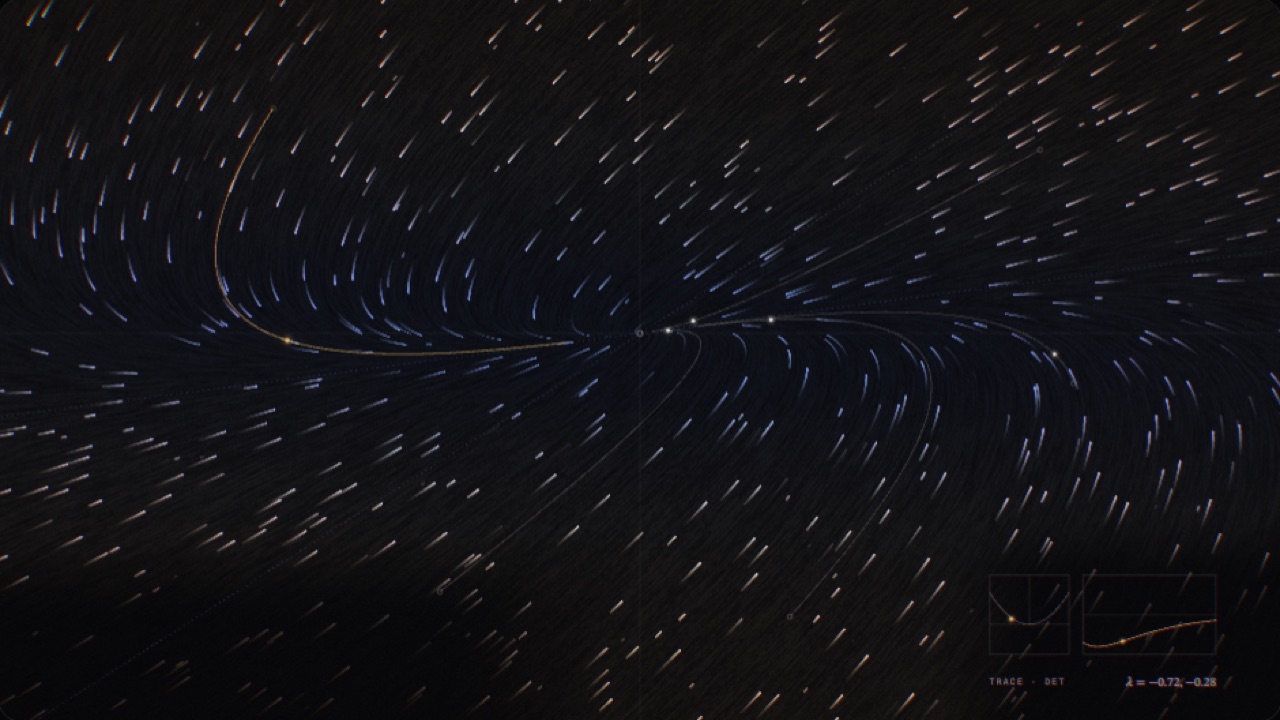
A differential equation x′=Ax puts an arrow at every point, and its solutions are the curves that follow them. For a two-by-two matrix the kind of motion is decided by its trace τ and its determinant Δ, because the eigenvalues solve λ2−τλ+Δ=0. Here the matrix walks a loop through the trace–determinant plane, and each frame shows the flow of the matrix it has reached; the plane is drawn in the corner with the parabola Δ=τ2/4 that divides real eigenvalues from complex ones. Every pixel follows the flow upstream, the comets run along the streamlines, and beside the plane the gold orbit's first coordinate is plotted against time.

Node
x′=Ax,λ1<λ2<0Both eigenvalues are real and negative. Every orbit falls towards the origin, and all but the two on the faster eigendirection arrive along the slower one, the one that belongs to λ2.
Spiral
λ=τ/2±i(Δ−τ2/4)1/2Across the parabola the eigenvalues turn complex. The imaginary part sets the orbits turning and the real part τ/2 still draws them in: a spiral sink.
Centre
τ=0,x(t)=eAtx0With zero trace and a positive determinant there is nothing to draw the orbits in or push them out. They close into ellipses, and the time plot in the corner is a pure oscillation.
Saddle
Δ=detA<0A negative determinant gives real eigenvalues of opposite sign. Orbits come in along one eigendirection and leave along the other; only those that start on the incoming line keep heading into the origin, and they never quite arrive. Then the matrix walks back to the node.

II Limit cycle

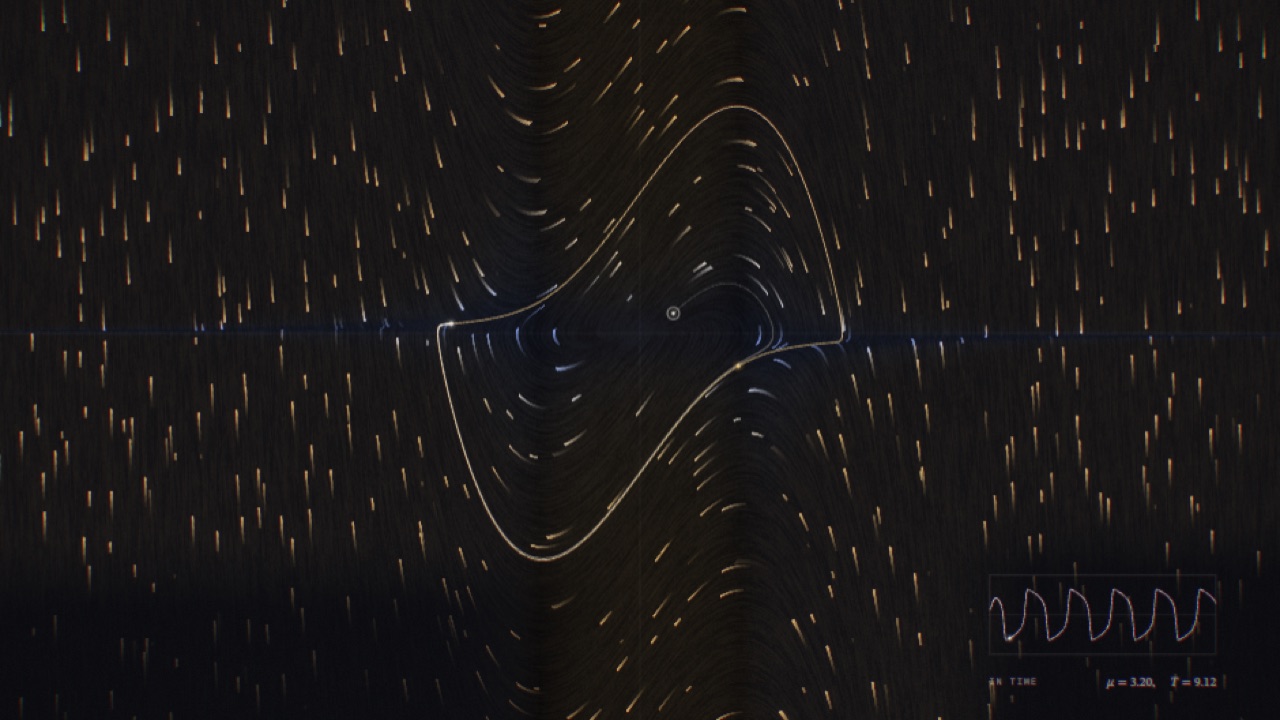
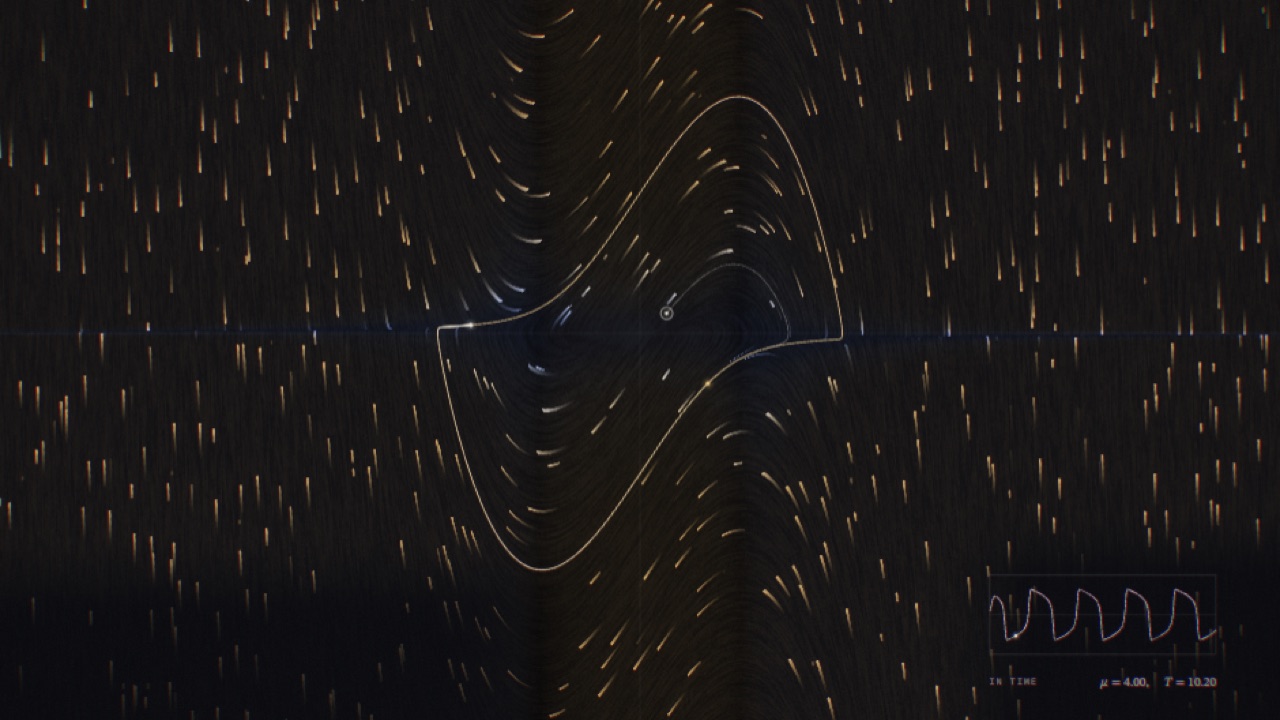
Balthasar van der Pol wrote this equation in 1926 for a circuit built around a triode. Its friction coefficient μ(x2−1) is negative inside the band |x|<1, where it feeds energy in, and positive outside it, so small oscillations grow and large ones shrink, and between them lies exactly one closed orbit that every orbit but the origin approaches: a limit cycle. The band where energy is fed in is tinted gold. The vertical axis is rescaled as μ grows, so that the cycle stays in view, and the corner plots x(t) once round the cycle and on.

Harmonic
x′′+x=0With μ=0 the equation is the harmonic oscillator. Every orbit is a circle and none of them is special; the gold one starts at (2,0).
A cycle is born
x′′−μ(1−x2)x′+x=0As soon as μ>0 the states near the origin are pushed out and faraway orbits are braked. Orbits from inside spiral out, orbits from outside spiral in, and they all close in on one cycle of amplitude close to 2.
Relaxation
x′=y,y′=μ(1−x2)y−xAt large μ the motion round the cycle splits into two slow crawls and two fast jumps: a relaxation oscillation, the kind that paces a heartbeat or a dripping tap. In the corner the sine wave has become nearly a square wave.
Slow and fast
T≈(3−2ln2)μFor large μ the period grows nearly in proportion to μ, nearly all of it spent crawling; at the μ=5 shown here the readout is still well above the formula. Then μ falls back to zero and the cycle relaxes into a circle again.

III Order and chaos

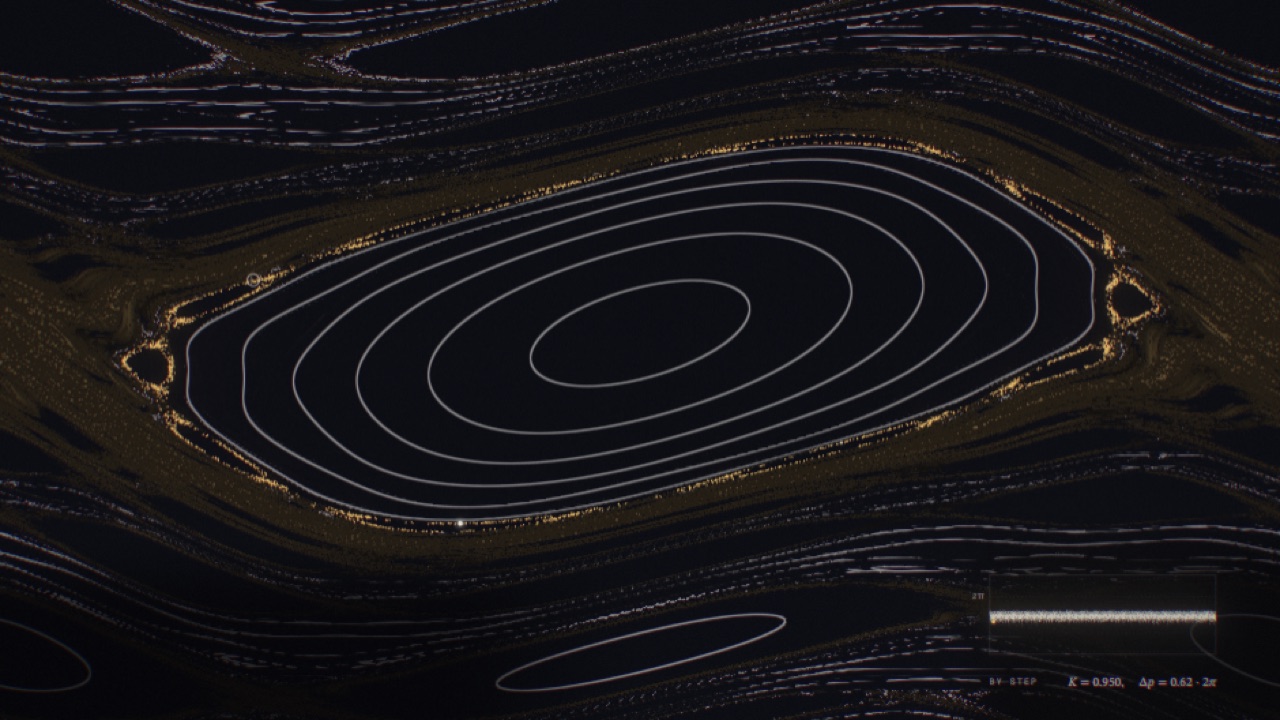
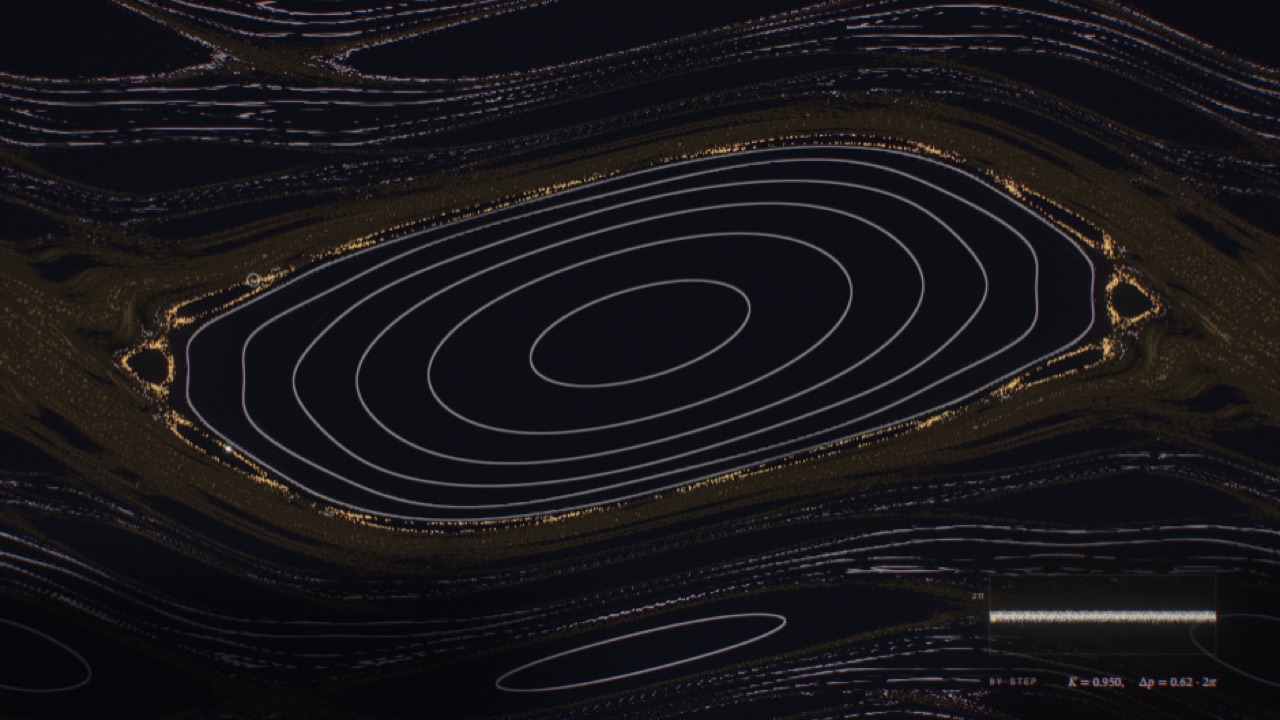
A frictionless pendulum conserves its energy, and that one fact organises its whole phase space: every orbit runs along a level curve of H. It also conserves area, which is Liouville's theorem, the defining property of a Hamiltonian flow. Instead of letting gravity pull steadily, kick the pendulum at regular intervals and let it turn freely in between; looked at just before each kick, it follows the standard map, the simplest place where order and chaos sit side by side. The corner plots in time the gold swing, and later one regular and one chaotic orbit of the map.

Pendulum
H=p2/2−cosθThe angle wraps round, so the phase space is a cylinder. Small swings close into ovals, large ones go over the top, and the dashed separatrix H=1 divides the two. The gold orbit swings just inside it and takes twelve seconds to come back.
Liouville
area(φtD)=area(D)A disc of starting points straddles the separatrix. Points inside the separatrix swing, points outside go round, and those near it take longest of all to come back, so the disc is sheared into a filament that winds round and round, while its area never changes. Every pixel is traced back in time to see whether it started in the disc.
Kicked
pn+1=pn−Ksinθnθn+1=θn+pn+1Kicked at regular intervals and left to turn freely in between, the rotor follows the standard map. For small K it is nearly the pendulum again, seen every K1/2 of a time unit; as K grows a chaotic layer opens along the separatrix and chains of islands appear. The ivory lines approximate the invariant curves, as level sets of an average taken along the orbit from each pixel, and the gold sea is where neighbouring orbits separate exponentially.
KAM
Kc≈0.9716Kolmogorov, Arnold and Moser proved that most invariant curves survive a small kick. Computations show that the last of those running all the way round to break is the golden curve, at K≈0.9716; beyond it the chaotic sea joins up and a chaotic orbit can wander without bound in p. Then the kicks soften and the pendulum returns.

IV Strange attractor

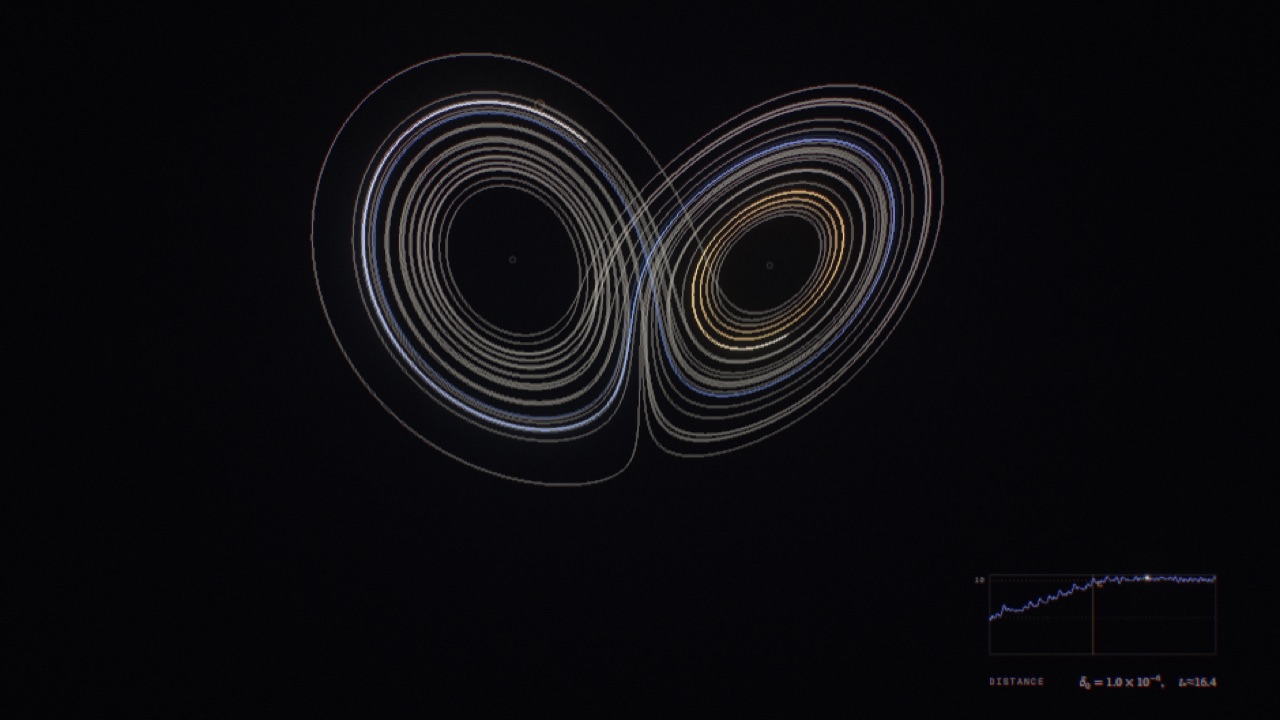
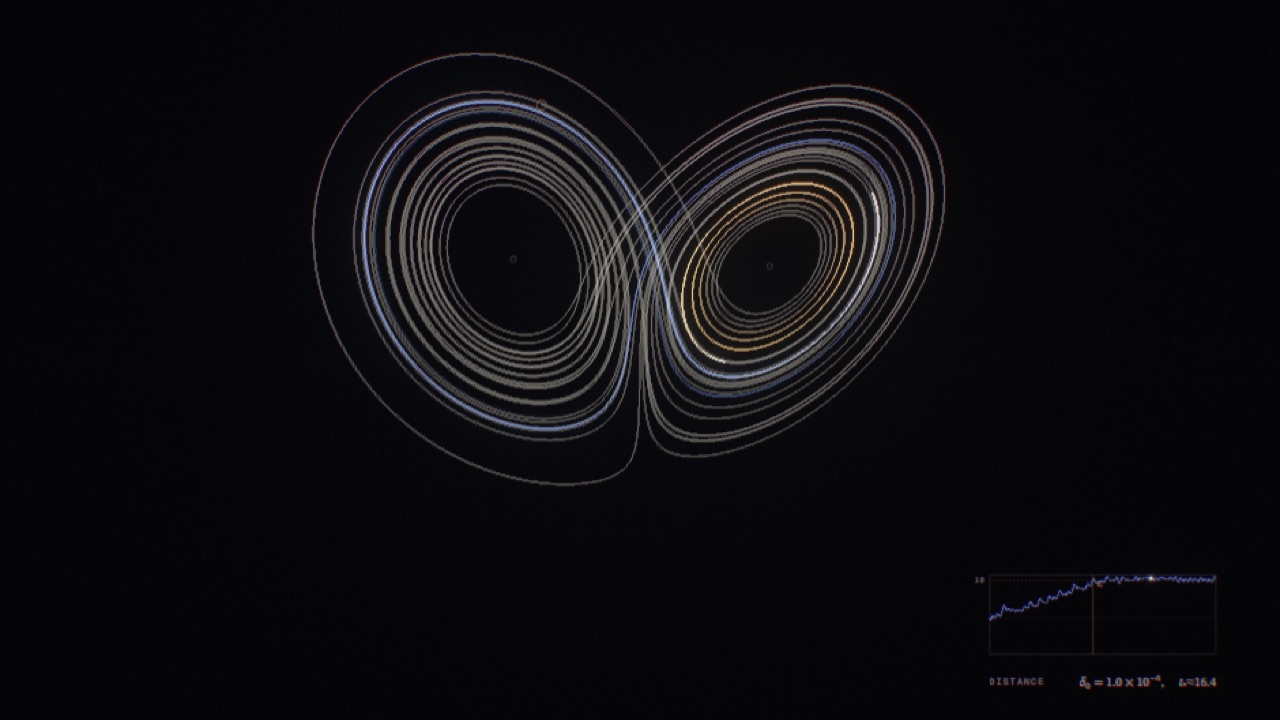
In 1963 Edward Lorenz cut a model of convection down to three equations and found that their solutions can go on forever without settling or repeating, yet are drawn onto the same winged shape. The orbits here are integrated in the browser, and the attractor is drawn in three dimensions, as hairlines of light, while the camera swings slowly from side to side in front of it. The corner plots each movement in time: one coordinate of the orbit, the two orbits overlaid, the size of the cloud, and finally the successive peaks of z.

One orbit
x′=σ(y−x)y′=x(ρ−z)−yz′=xy−βzOne orbit from (1,1,1). It swings round one of the two fixed points C± a few times, then crosses to the other, and the sequence of turns between crossings never repeats. In the corner x(t) flips sign whenever the orbit changes wing.
Two orbits
|δ(t)|≈|δ0|eλt,λ≈0.906Two orbits start a thousandth apart. For a while they are one line; the gap grows by a factor e about every time unit, and after ten units they are on different wings. This is the sensitive dependence Lorenz found when he restarted a run from rounded numbers.
A cloud
∇·f=−(σ+1+β)≈−13.7Two thousand four hundred starting points in a small ball. Volumes shrink by a factor e13.7 every time unit, yet the cloud spreads over both wings: it is squeezed flat and stretched long at once, onto a set of dimension about 2.06. Gold points are on one wing and blue on the other.
Lorenz's map
zn+1≈F(zn)Lorenz noticed that each peak of z almost determines the next. Plotted against each other, the peaks fall very nearly on a single tent-shaped curve: the chaos of three equations is, almost, the chaos of a one-dimensional map that stretches and folds.

V Road to chaos

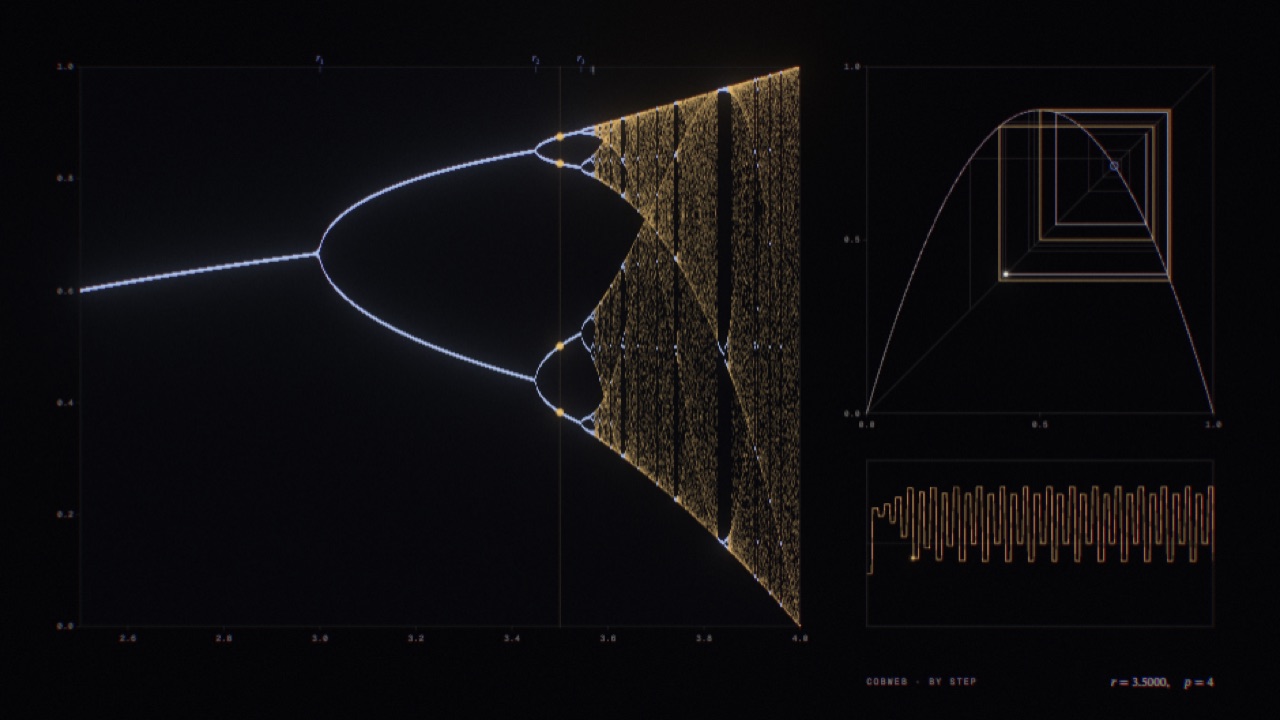
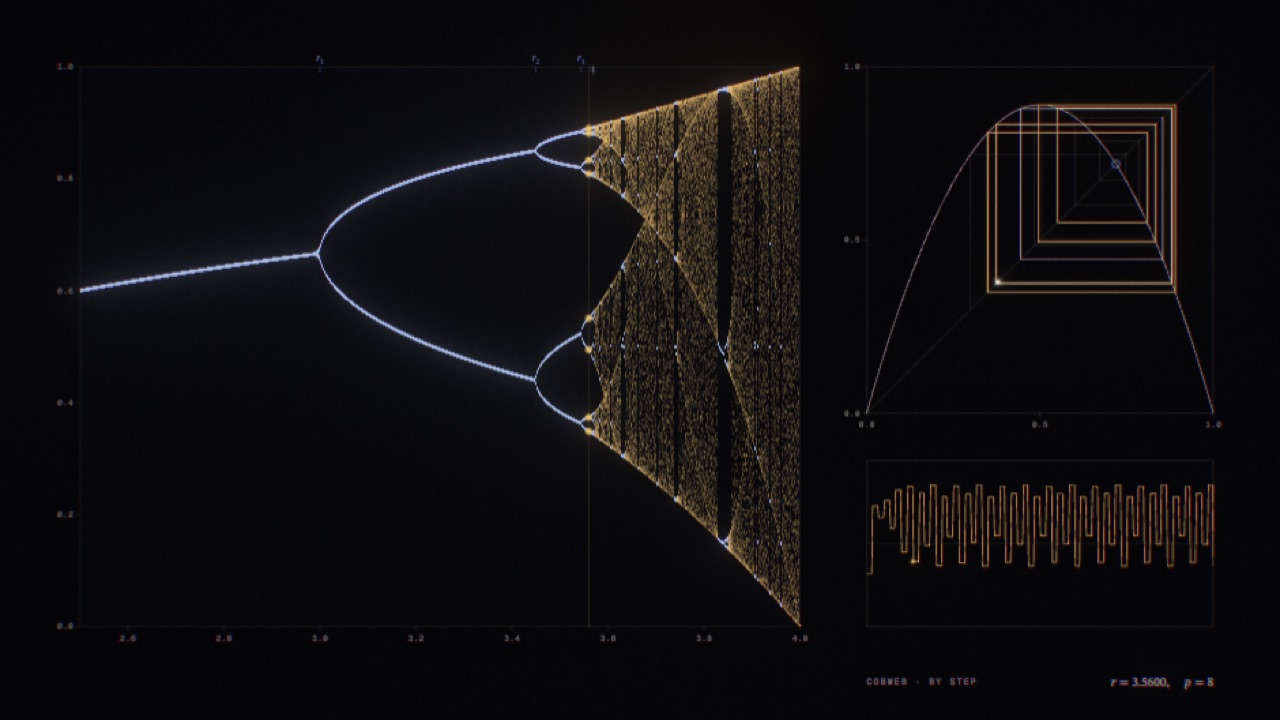
The logistic map multiplies a population, counted as a fraction of what its world can hold, by r and by the room it has left. The main picture is its bifurcation diagram, computed pixel by pixel: every column holds one value of r, whose orbit is iterated until it forgets where it started and then plotted, bright where the orbit keeps returning, blue where it is periodic and gold where it is chaotic. The gold cursor walks along r; in the corner the cobweb follows the orbit on the graph of the map, and beside it the same orbit is plotted in time.

Fixed point
xn+1=rxn(1−xn)For r between 1 and 3 every orbit that starts between 0 and 1 settles towards a single value, the fixed point 1−1/r. In the cobweb the staircase closes in on the place where the curve crosses the diagonal away from the origin.
Period doubling
δ=lim(rn−rn−1)/(rn+1−rn)≈4.669Past r=3 the fixed point loses its stability and the orbit alternates between two values; past r2=1+61/2 it cycles through four, then eight, then sixteen. The ratio of each gap between doublings to the next tends to Feigenbaum's δ, and the doublings pile up at r∞≈3.5699.
Chaos and windows
r=1+81/2≈3.828Beyond r∞, for many values of r the motion is chaotic: the Lyapunov exponent is positive and the orbit never repeats. Yet windows of order open inside the chaos. The widest is period three, born at 1+81/2, and period three, as Li and Yorke showed, implies orbits of every period.
Feigenbaum
α≈−2.503,δ≈4.669Magnified about r∞ by δ across and by |α| up and down, the cascade looks nearly the same again, and more so at each level, turned upside down each time because α is negative. Two levels in, the picture is magnified about forty-five times across; then it draws back to the whole diagram.