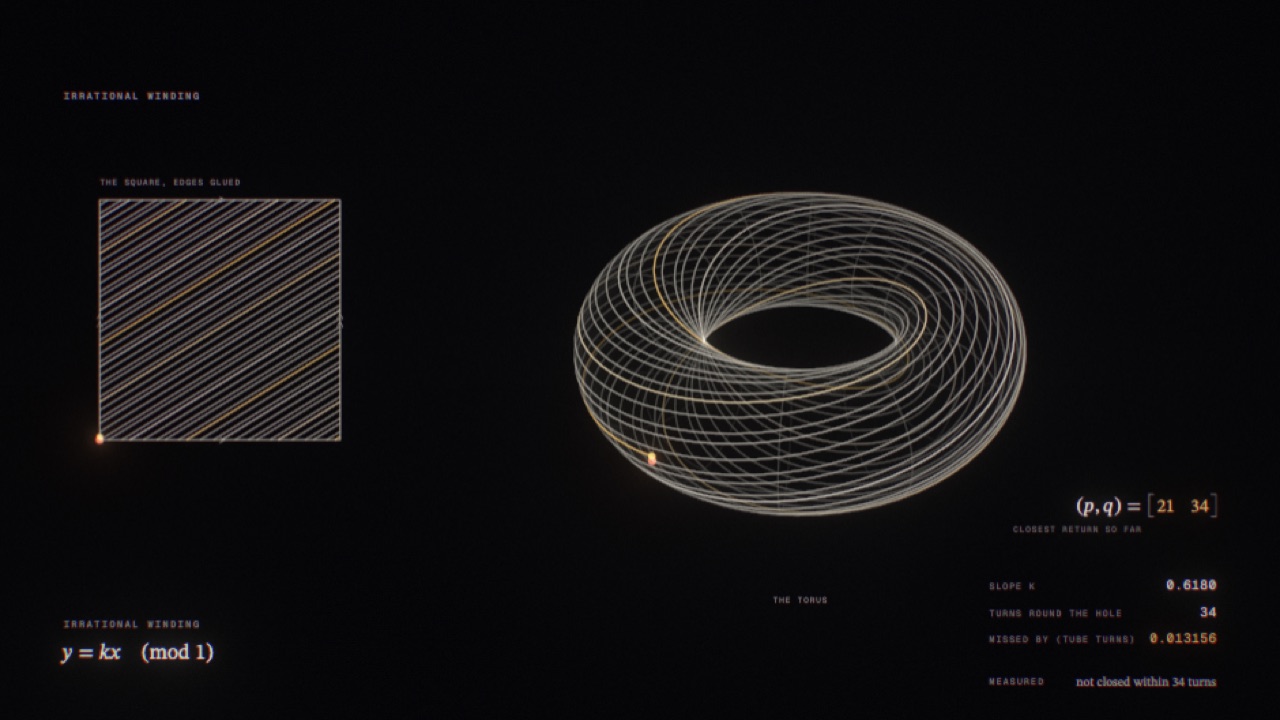
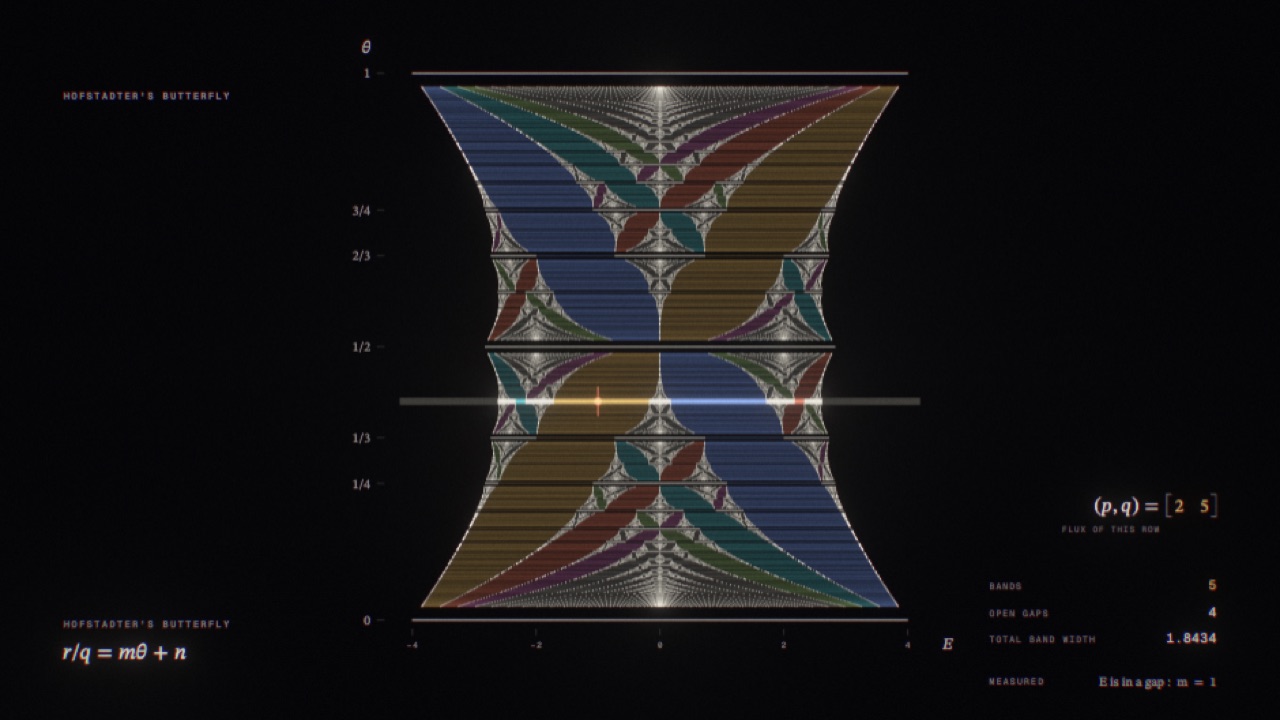
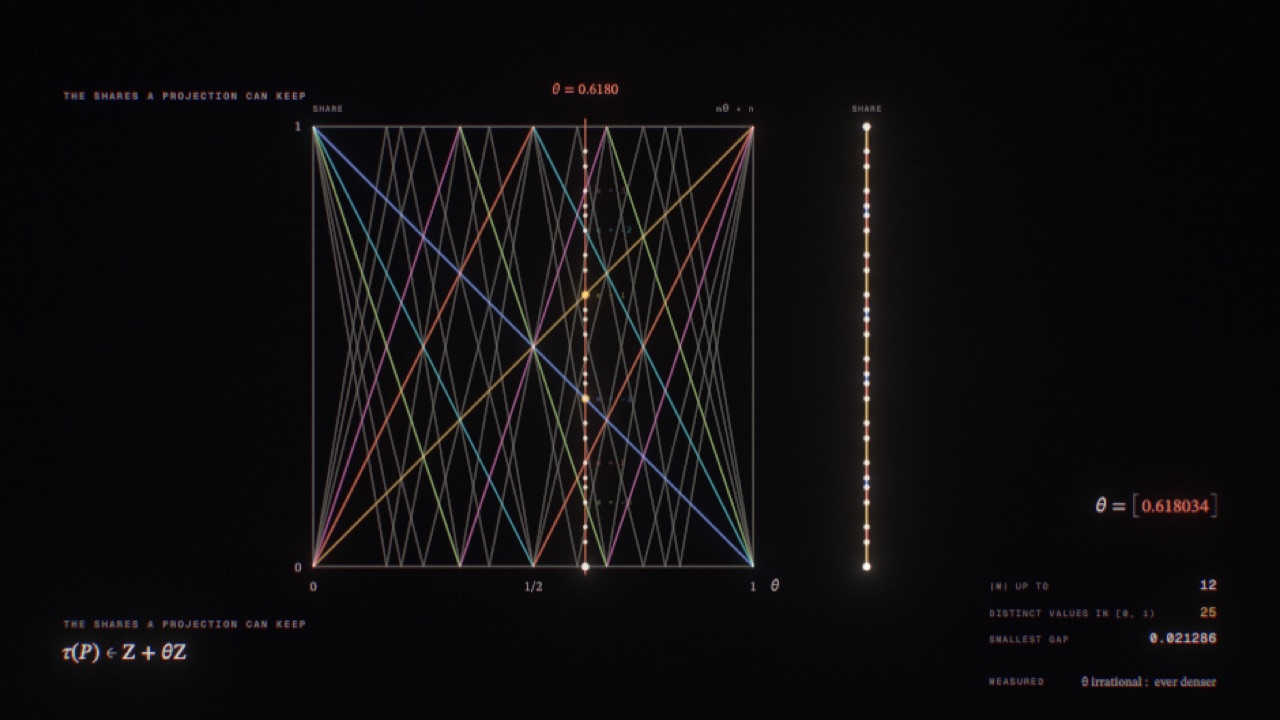
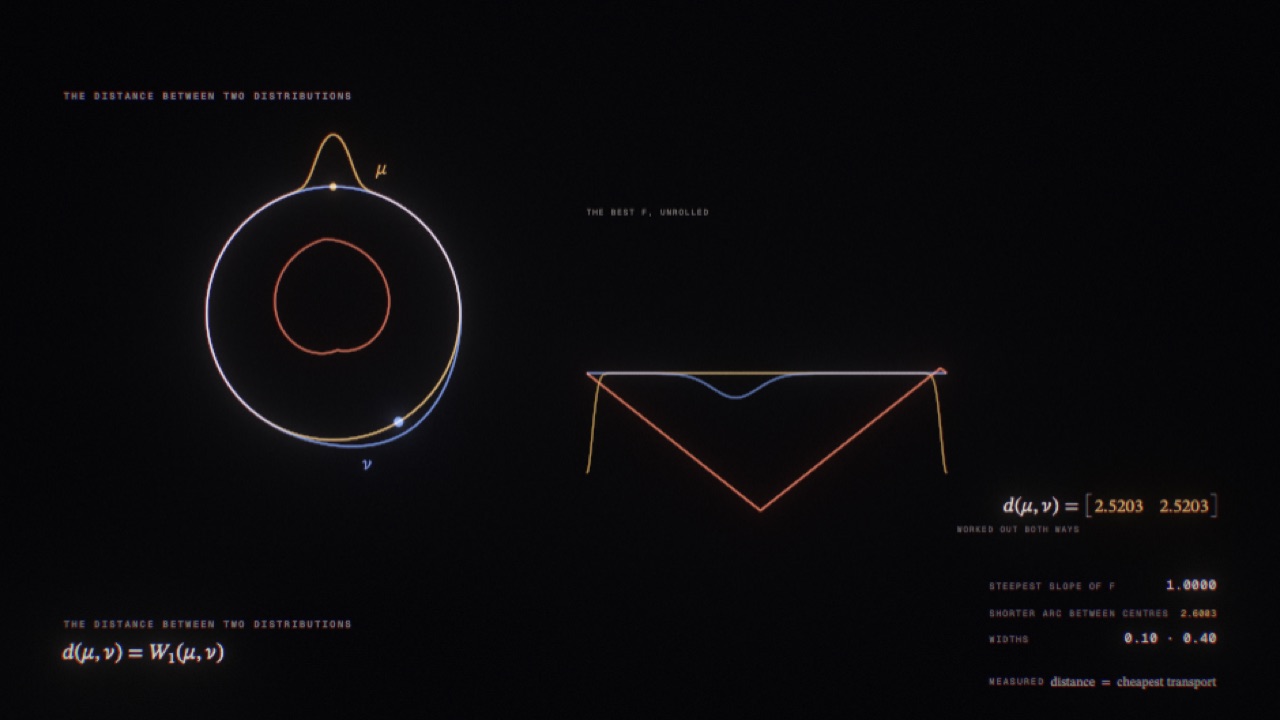
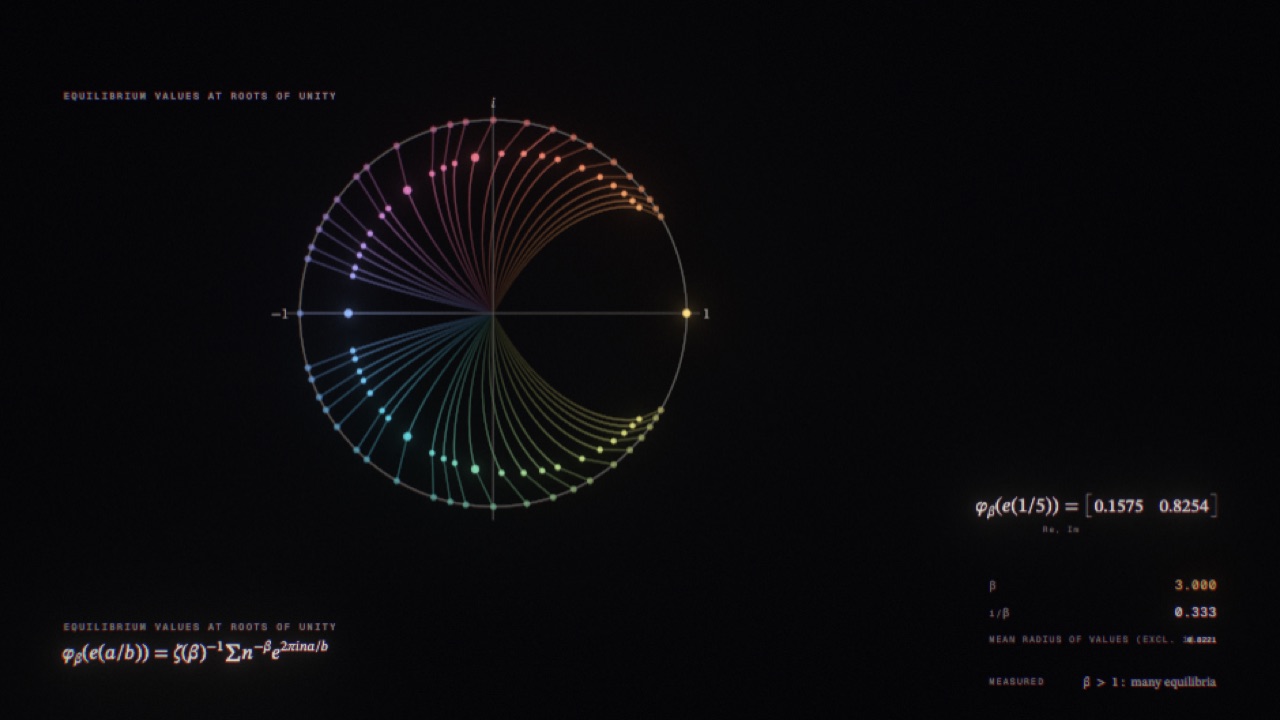
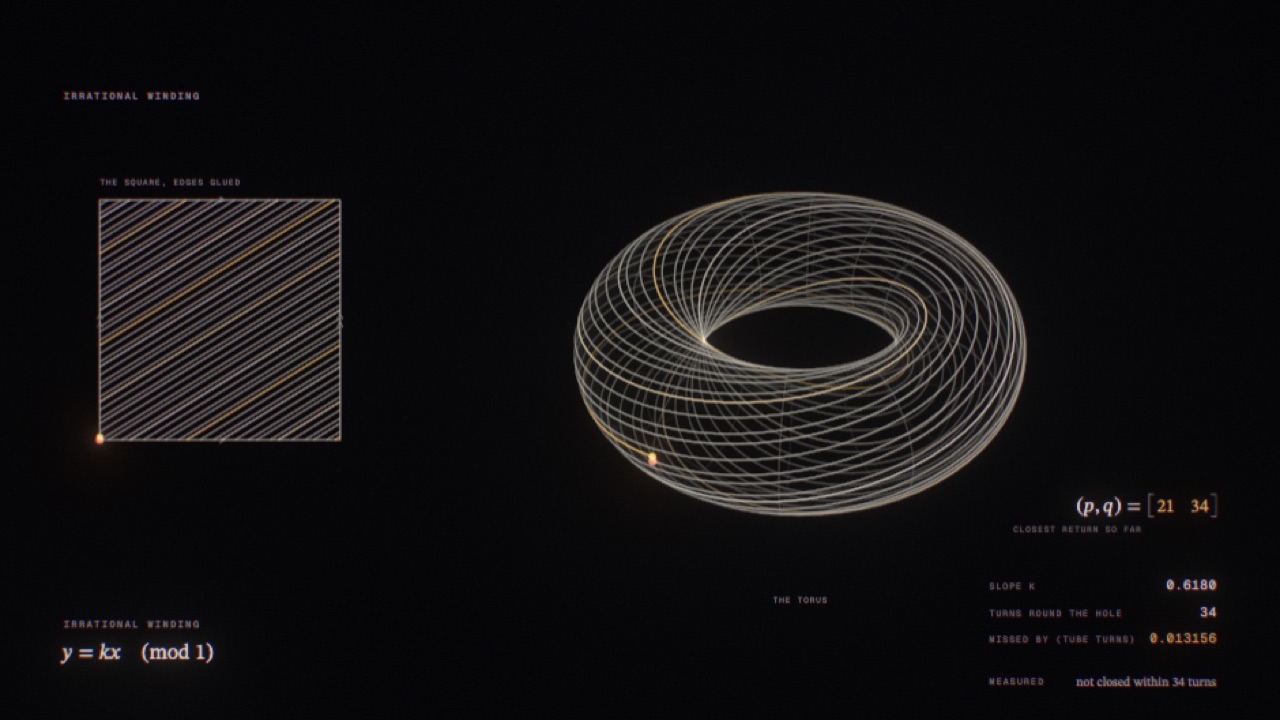
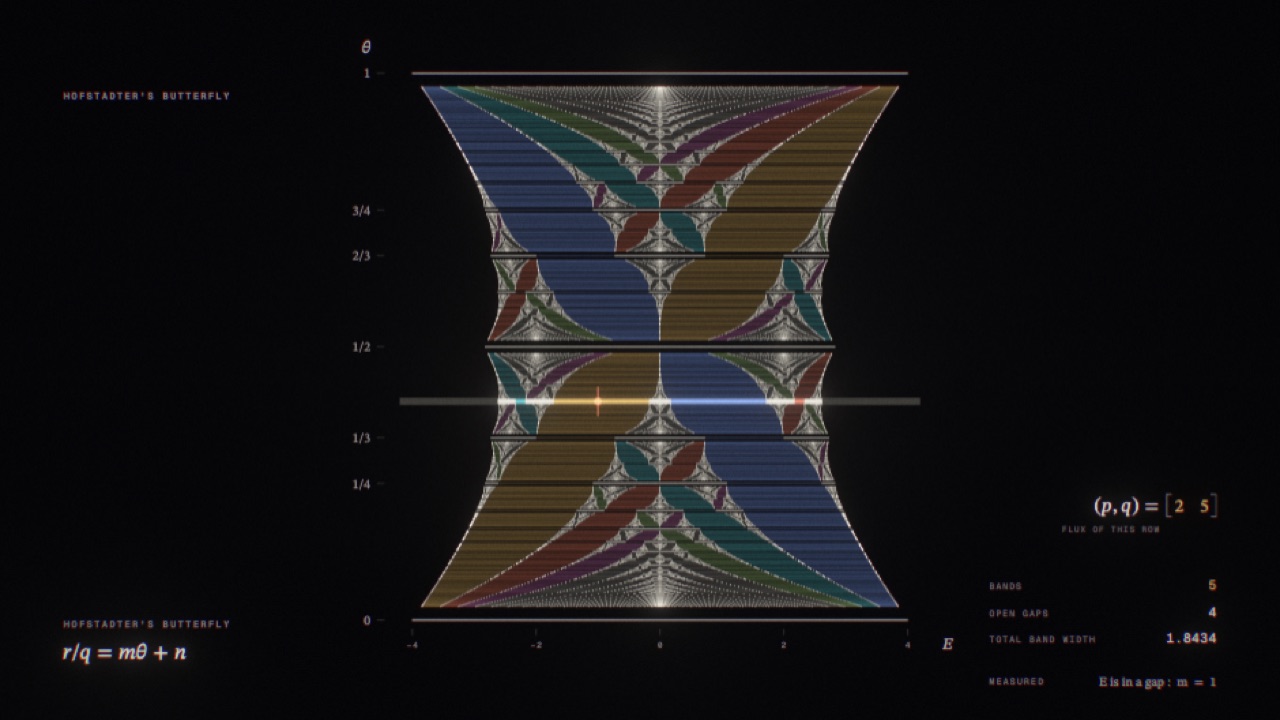
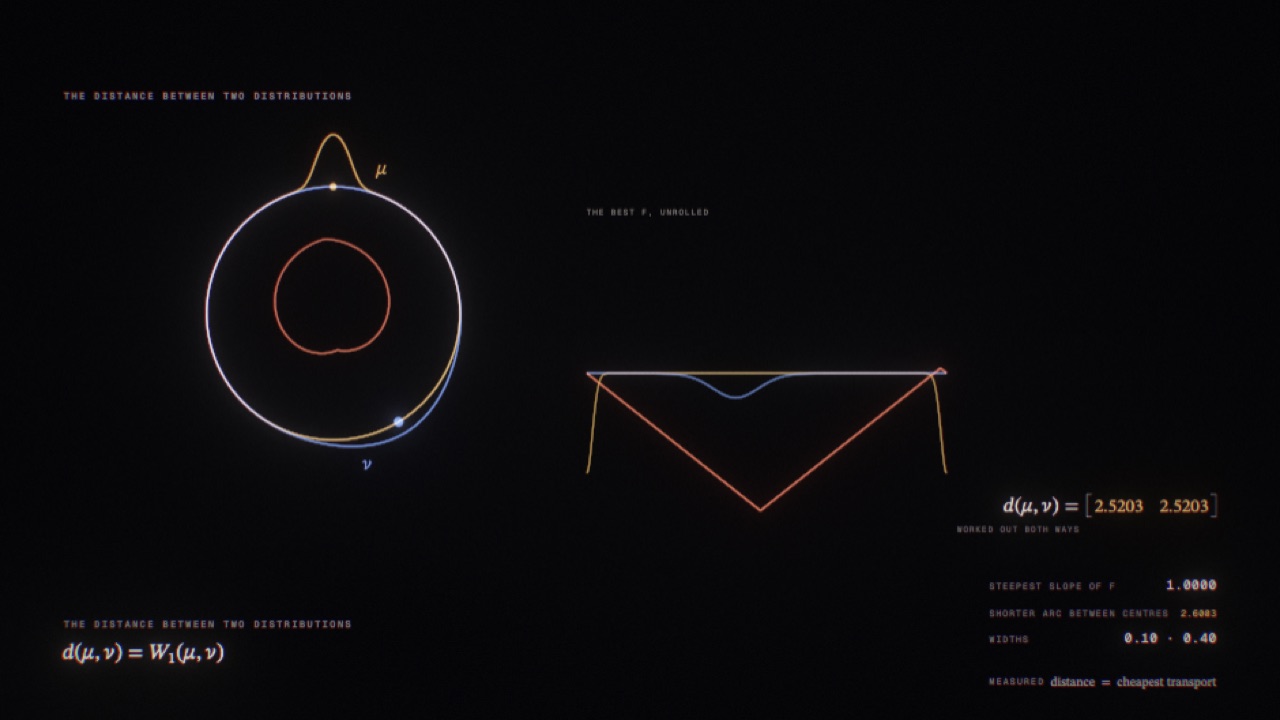
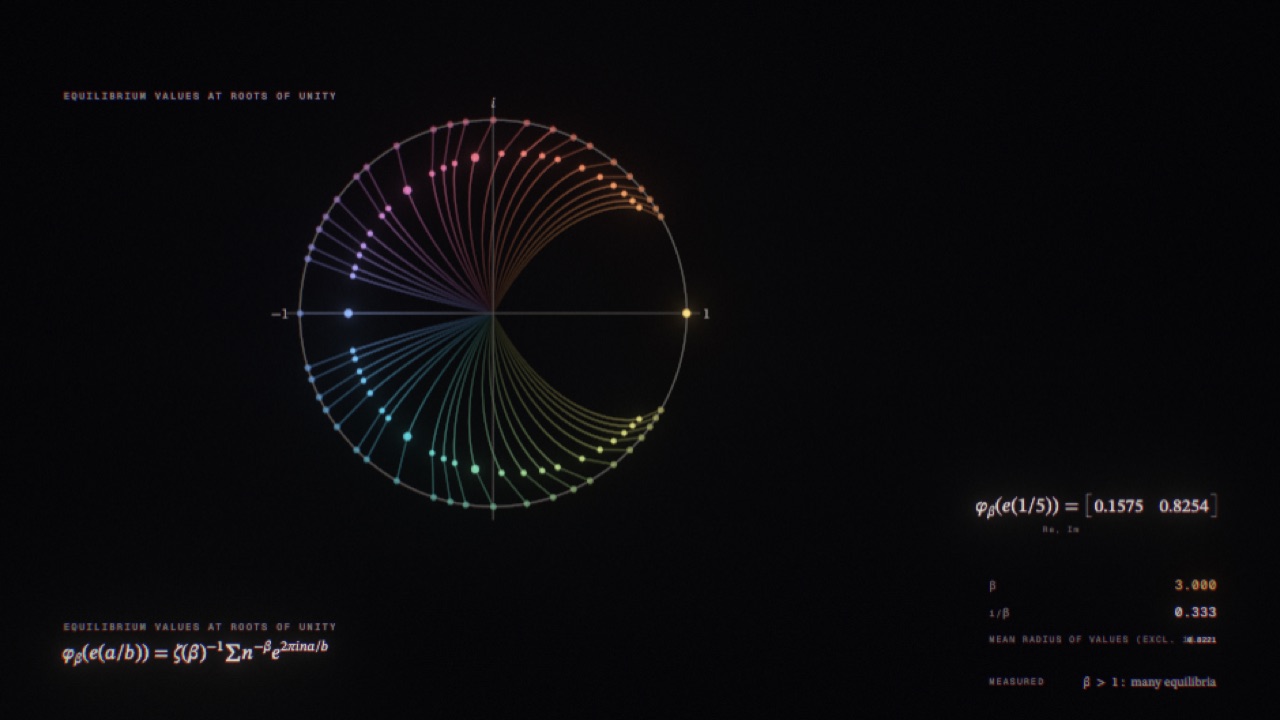
Plates on noncommutative geometry, each one computed in the browser as you watch: the irrational winding, a straight line of irrational slope on a torus that never closes, whose lines no continuous function can tell apart and whose space is replaced by two operations that commute only up to a turn, UV=e2πiθVU; the Hofstadter butterfly, an electron hopping on a lattice in a magnetic field whose two hops obey the same relation, its energies computed row by row for every flux p/q, a small butterfly inside one band and the gaps coloured by the Hall conductance, an integer in units of e²/h; a projection of trace θ, built by Rieffel from two functions on the circle, squared along one orbit without changing, the blocks the plate cuts out of it having eigenvalues 0 and 1 only, the ones a Fibonacci fraction of the sites; distance without paths, Connes's formula giving back the length of an arc, the transport distance between two distributions and a distance between two points with nothing between them, and the dimension of a torus read from how its spectrum grows; and primes at a temperature, the Bost–Connes system whose energy levels are log n, its partition function the Riemann zeta function and its modes the primes, its phase transition at β = 1, and the values its equilibrium states give the roots of unity, which move from 0 out towards the circle as the system cools. The corner keeps the numbers that describe what is drawn and checks them against the picture.
Plates
I–V
Loop
60 s each
Resolution
Matches the stage, up to 4.4 MP
Frames prerecorded
None
Film
In production
Plate I · 4 movements · 1:00 loop
The irrational winding
Glue the opposite edges of a square and it becomes a torus; a straight line on the square becomes a line wound around it, once around the big circle each time it crosses the square, and round the tube as often as its slope says. The plate draws the line twice, flat in the square on the left and wound on the torus on the right. If the slope is a fraction p/q the line closes after q turns. If it is irrational it never closes, and comes as close as you like to every point. Then a continuous function that takes one value on each line must take the same value everywhere: the usual way of describing a space, by the functions on it, sees the space of these lines as a single point. Alain Connes's answer is to describe it by operators instead: here a shift by θ and a multiplication by e2πix, which no longer commute. The corner keeps the numbers that describe the line and checks them against the picture.
Plates
Studio
This volume's pictures, in your hands: change a parameter and watch the picture follow.
A compact Hausdorff space can be recovered from the algebra of continuous complex functions on it, and that algebra is commutative. Some spaces, like the space of lines in the first plate, have too few functions to be recovered this way. Noncommutative geometry keeps an algebra anyway, one that no longer commutes, and studies it as if it were the functions on a space. For the irrational winding that algebra is the noncommutative torus, generated by U and V with UV=e2πiθVU.
One θ, three plates
Plates I to III are tied together by the same integers. The traces of the projections in the noncommutative torus take exactly the values mθ + n between 0 and 1, with m and n integers (Pimsner and Voiculescu, Rieffel); plate III runs the rotation of plate I backwards, which leaves these values unchanged, builds the projection whose trace is θ, and draws a sample of the rest on a line. For a gap of the butterfly at flux α, the fraction of states below it is mα + n, the trace of the matching spectral projection, so the gaps of plate II are labelled by the K-theory of the algebra of plate I.
Computed in the browser
Nothing on screen is read from a precomputed table. The edges of the bands at θ = p/q are where D(E) = 4 and D(E) = −4, the eigenvalues of a periodic and an antiperiodic q × q matrix. Each is found by counting: factor the matrix minus E, count the negative pivots, and that is how many eigenvalues lie below E; bisection then pins each one down to the precision of the arithmetic, however close it is to its neighbour, with no scan over energies to miss a narrow gap. The 491 rows of the full butterfly take about a tenth of a second on a laptop; the rows of the zoomed window are computed between frames while the earlier movements play, and kept once computed.