yAtlas

Drawing the first frame…

0:00 / 9:04Prologue

The Order Beneath · No.01 · Rendered in real time · 9:04

Conformal

A short film about preserving angles

Complex analysis in seven short chapters, from a warped sheet of graph paper whose tiniest cells are still square to the Riemann sphere, the hyperbolic plane and the Mandelbrot set. Every frame is computed by code; on the website, each one is drawn live in your browser as the film plays.

Runtime
9:04
Chapters
Seven, with a prologue and a coda
Resolution
Matches the player, up to 4.4 MP
Frame rate
Up to your display’s refresh rate, depending on the device
Prerecorded frames
None
Languages
English · 日本語 · 中文

Try it yourself

Each of these moments in the film opens in the Studio, where you can try the idea yourself.

  1. Drag the zeros and poles and watch the colours windII · Painting a function
  2. Spin, raise, slide and tip the sphere yourselfIV · The point at infinity
  3. Change the sides and the tiles per corner: do they cover a plane, a sphere or the hyperbolic plane?V · An infinite plane in a disc
  4. Walk along the axis and bring an octagon in from the rimV · An infinite plane in a disc
  5. Drag c and crumple the boundary into petalsVII · One piece or dust?
  6. Drag c out of the Mandelbrot set and watch the Julia set turn to dustVII · One piece or dust?

Chapters

Studio

This volume's pictures, in your hands: change a parameter and watch the picture follow.

Where it turns up

Places in the world where this volume's mathematics turns up. Each card links to a related Studio.

Transcript · 53
  1. Prologue

  2. INumbers in the plane

  3. IIPainting a function

  4. IIIPreserving angles

  5. IVThe point at infinity

  6. VAn infinite plane in a disc

  7. VICircles in circles

  8. VIIOne piece or dust?

  9. Coda

Plate notes · 5

I Domain colouring

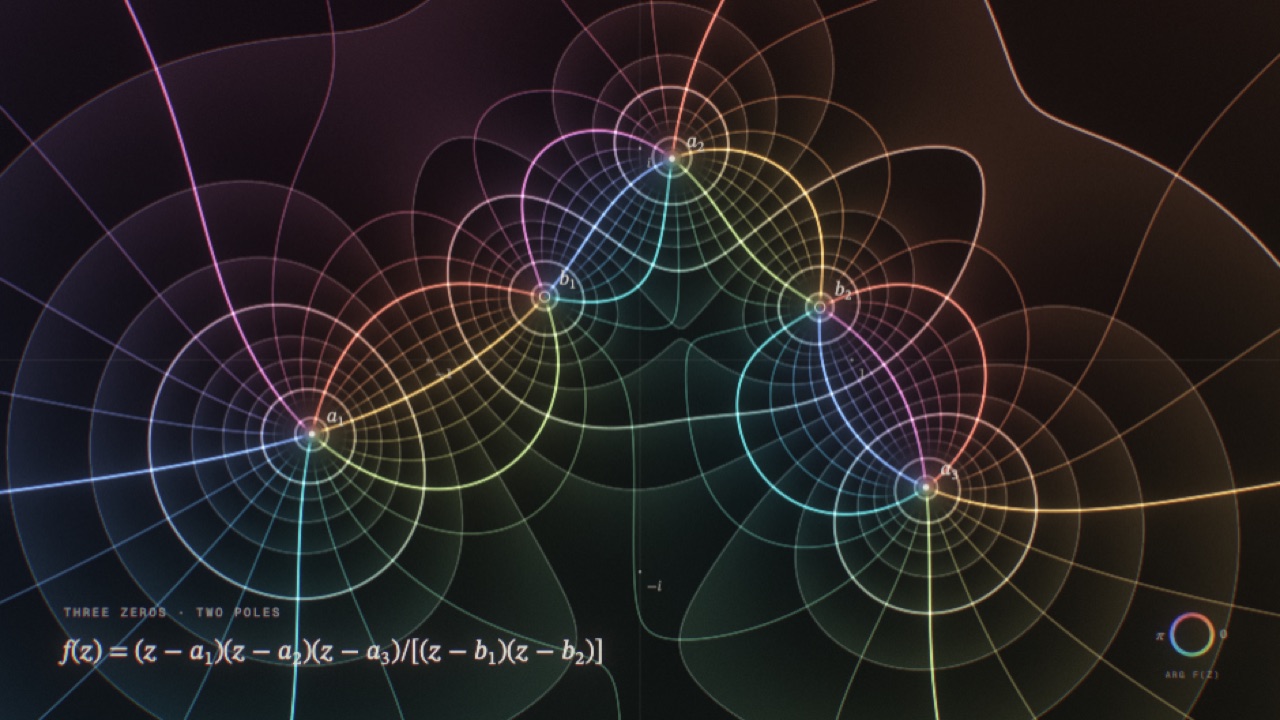
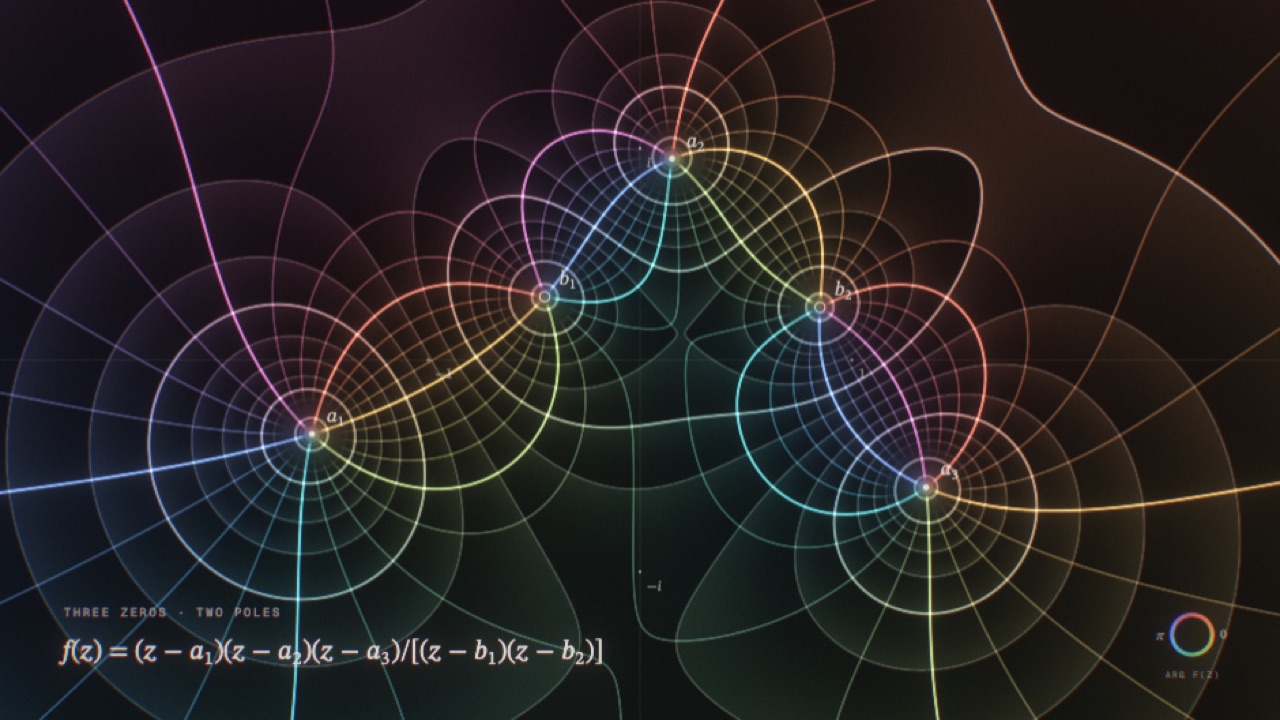
Every point z is painted with the value f(z). The hue is its direction, argf: gold where f(z) is a positive number and ice-blue where it is negative. The rings are curves on which |f| is constant, each a fixed factor larger than the last, and the rays curves on which argf is constant, each a fixed angle round from the last; the two steps are matched, so between them the plane is cut into cells that are nearly square. The rings drift the way |f| grows and the rays the way argf grows. The hue itself stays put.

The plane itself
f(z)=zFor f(z)=z every point is painted with its own position: one zero at the origin, every colour once around it, the rings stepping out by the same ratio all the way.
Three roots
f(z)=z3−1The zero at the origin moves out to 1, and two more arrive from infinity. Each colour appears once around each of the three zeros, and three times around a large circle: the argument principle, counting the zeros inside.
Zeros and poles
f(z)=(z3−1)/(z3+1)Three poles settle between them, points where f grows without bound. Around a pole the colours run the other way round, and the rings flow out of the zeros and into the poles.
An essential singularity
f(z)=e1/zAll six points fall into the origin and cancel, and e1/z takes their place. Its singularity at 0 is essential, neither a zero nor a pole: in every neighbourhood of 0 it takes every non-zero value infinitely often, as Picard showed every essential singularity must, missing at most one value. So every colour returns there without end.

II The Riemann sphere

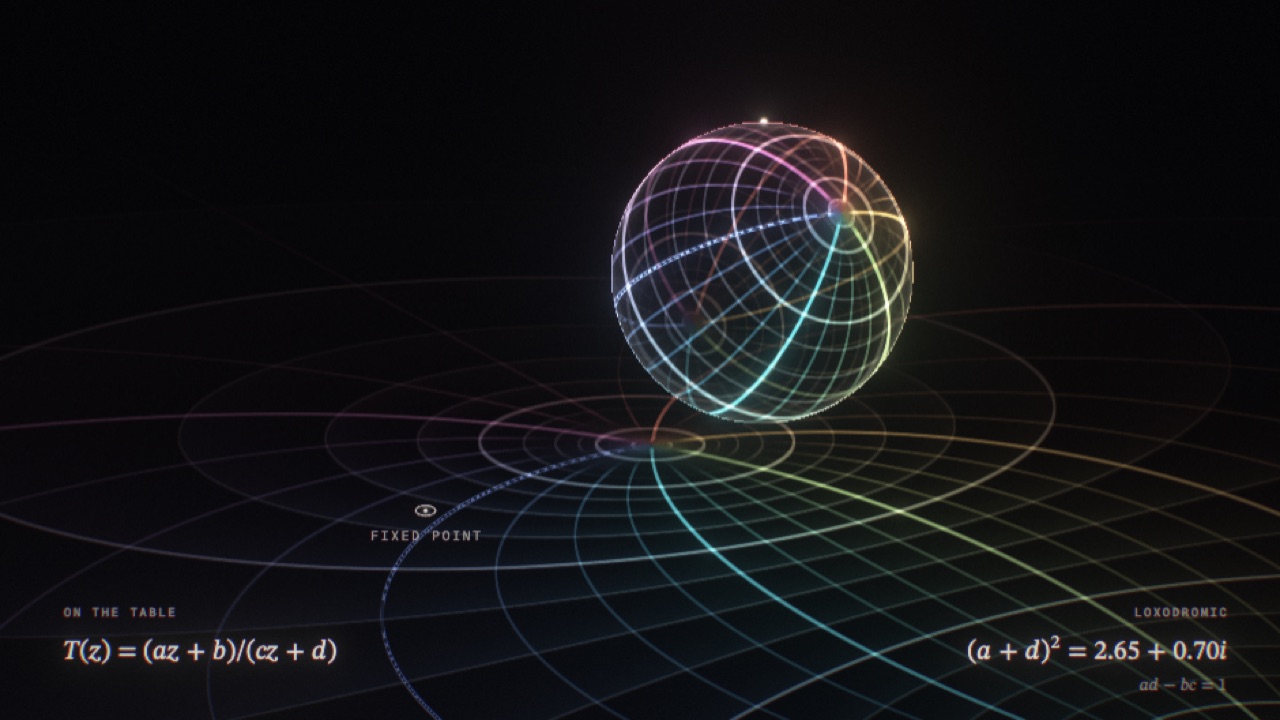
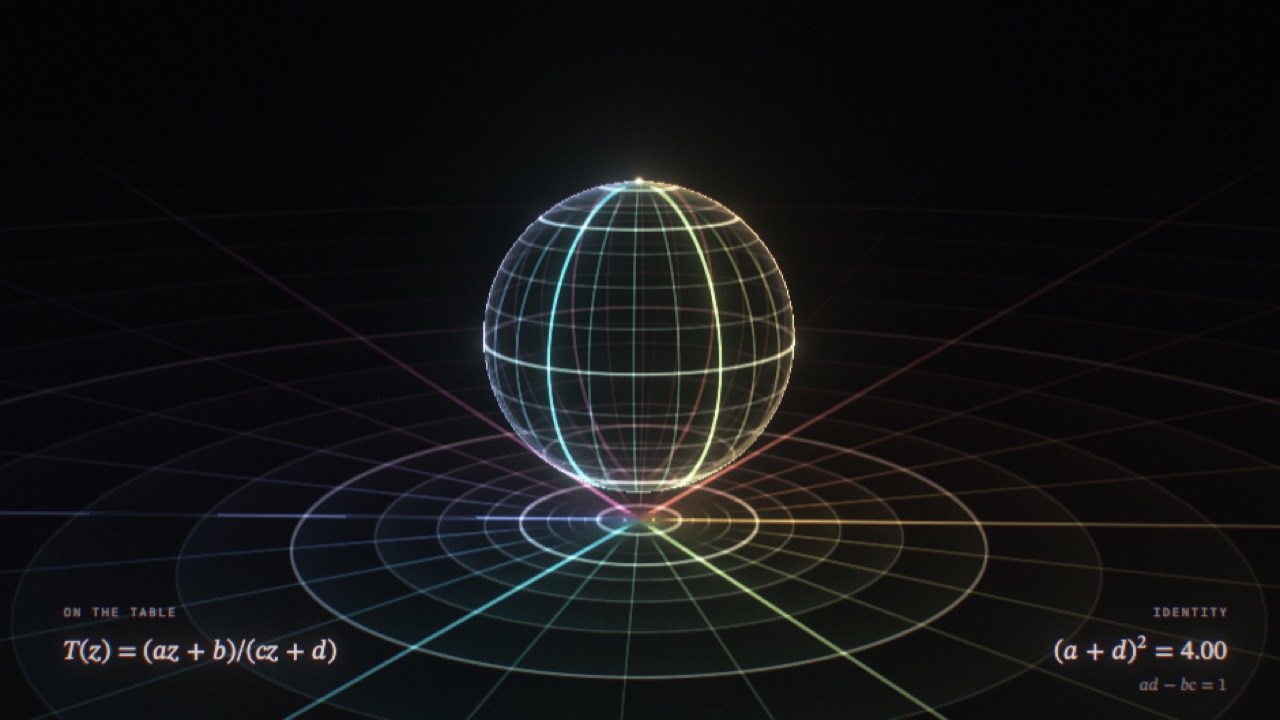
A glass sphere floats above the plane with a light at its highest point, and the light throws the lines drawn on the sphere onto the plane: stereographic projection, which keeps every angle and sends circles to circles, or to straight lines when they pass through the light. Move the sphere rigidly, the light staying at its top, and the picture below changes by a Möbius transformation, a map z↦(az+b)/(cz+d). Each movement here ends where it began, so the loop has no seam.

Projection
(x,y,h)↦(x+iy)/(1−h)The grid on the sphere is made of small, nearly square cells (meridians, and parallels placed where a Mercator map would draw them evenly spaced), and so is its shadow on the plane: the projection keeps angles.
Rotation
z↦eiθzSpin the sphere about its vertical axis and the plane turns about 0. Two points stay put, 0 and ∞: the elliptic case.
Dilation
z↦kz,k>0Lift the sphere and the light rises with it: the picture swells away from 0 and settles back. The hyperbolic case: points stream from one fixed point towards the other.
Spiral
z↦keiθzDo both at once and the points spiral. Repeat one such step again and again and each point runs along a loxodrome on the sphere, the course of a ship holding a constant bearing, winding from one fixed point towards the other: the loxodromic case.
Translation
z↦z+bSlide the sphere and the picture slides with it. Only ∞ stays fixed: the parabolic case.
Tumble
z↦(zcosθ+isinθ)/(izsinθ+cosθ)Turn the sphere about a horizontal axis and the transformation is elliptic again. The fixed points are the two ends of the axis, projected to ±1; everything else circles them, and 0 is carried up the imaginary axis to ∞ and back from the other side.

III The hyperbolic plane

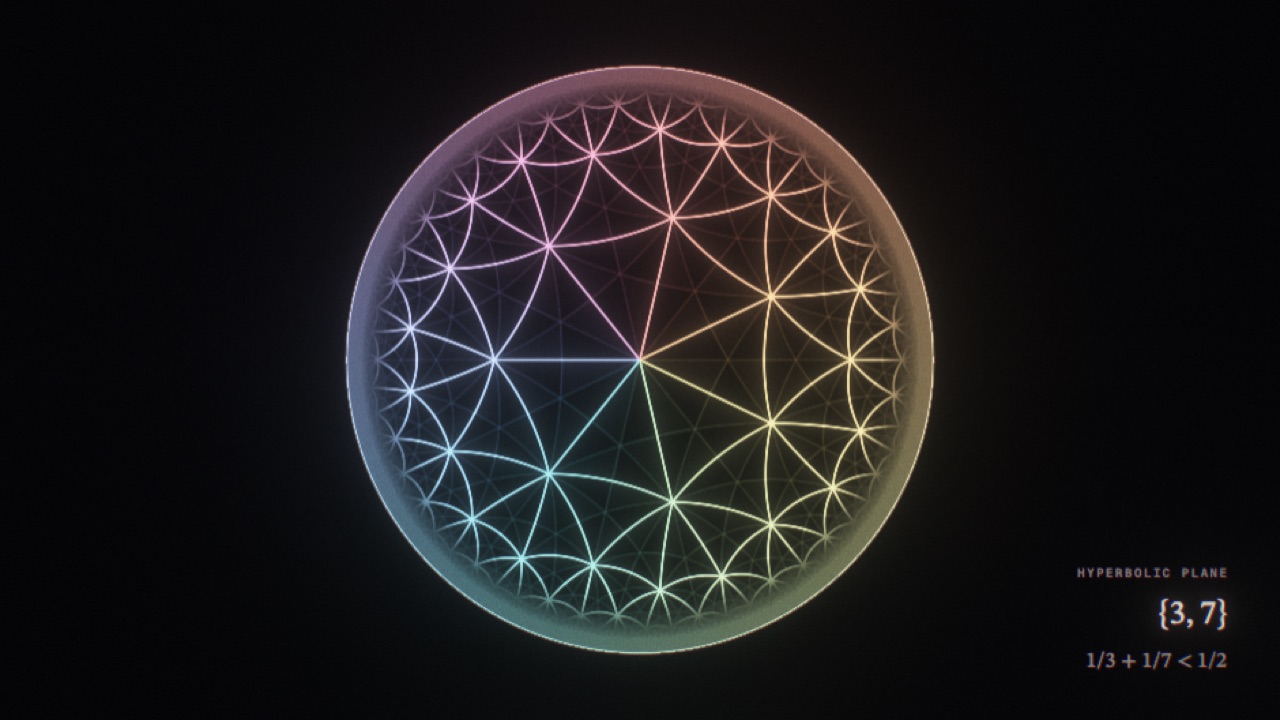
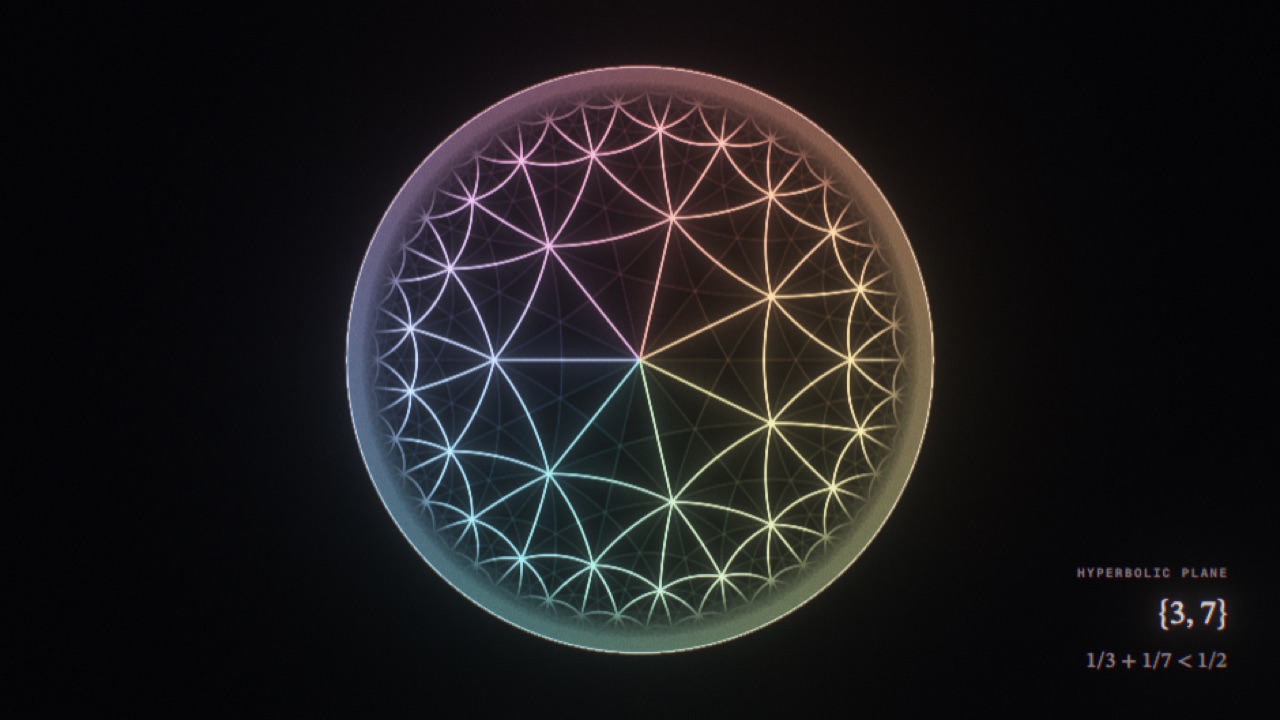
The disk holds the whole hyperbolic plane. Its rim is infinitely far away, and all the tiles are the same size; they only look smaller towards the edge. The tiling is made the way the kaleidoscope in Invariant, the prologue film, was: each pixel is reflected back into one small triangle, two of whose mirrors are straight and the third a circle meeting the rim at right angles, and the reflections are counted. The colour is the first plate's colour wheel again, here giving the direction of each point from the centre.

One triangle, reflected
⟨a,b,c∣a2=b2=c2=e,(ab)8=(bc)3=(ca)2=e⟩Octagons, three at every corner: {8,3}. The tiling grows from one triangle, one reflection at a time. Call the three mirrors a, b and c: every triangle is reached by a string of reflections, a word, and the count is the length of the shortest one. The formula lists the rules these words obey, with e for doing nothing; every other rule follows from them.
Duality
{8,3}→{3,8}The same mirrors, with a different side of the triangle drawn. Join the centres of neighbouring octagons and you get triangles, eight at every corner: {8,3} and {3,8} come from one group.
Translation
z↦(z+a)/(az+1)Slide the plane along a diameter, z↦(z+a)/(az+1) with −1<a<1. The tiles stream out of one point on the rim and into the opposite one; each time an octagon reaches the place of its neighbour, the tiling lands exactly on itself, and the plate slides two such steps.
Every p and q
1/p+1/q<1/2{p,q} means p-sided tiles, q at every corner, and every pair of whole numbers with 1/p+1/q<1/2 tiles the hyperbolic plane; here {7,3}, {5,4} and {4,6}. The flat plane has only three regular tilings, and the sphere, leaving aside the degenerate ones, only five, the Platonic solids.

IV Julia and Mandelbrot

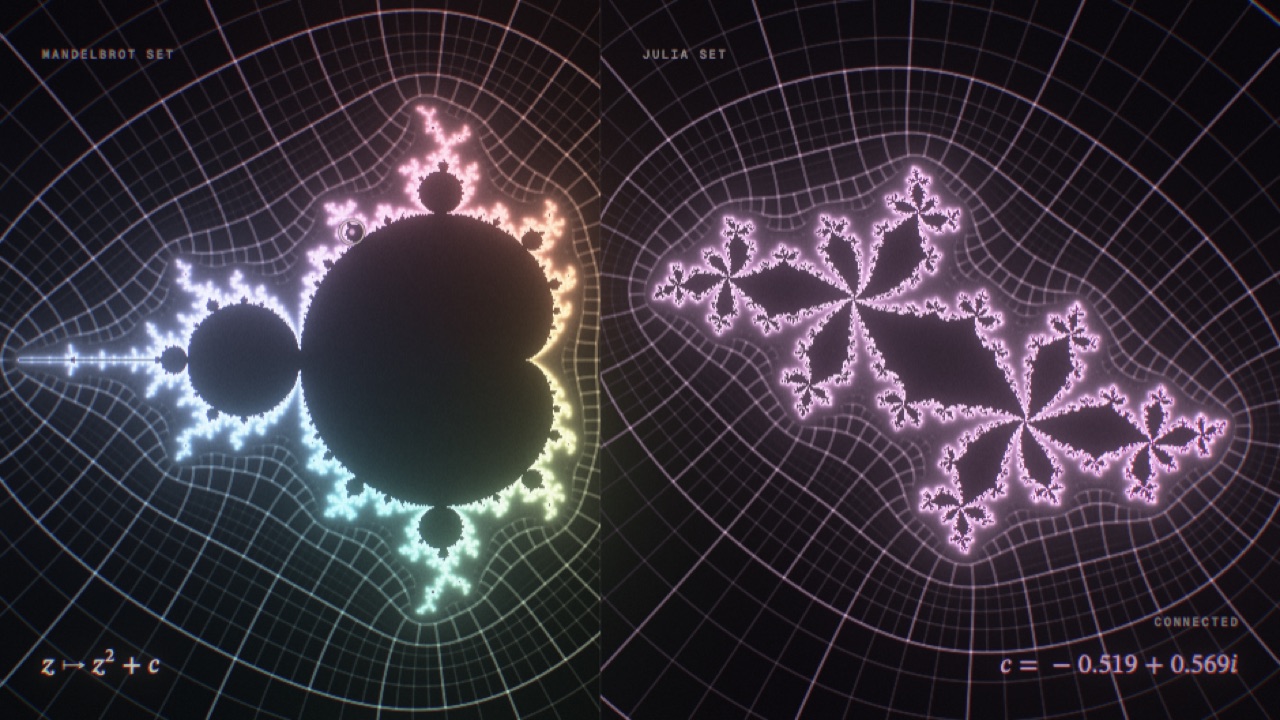
Everything on this plate comes from one map, z↦z2+c, applied again and again; the points a starting value visits are its orbit. The Mandelbrot set is the set of parameters c for which the orbit of 0 stays bounded; for each c there is a Julia set, the boundary of the points whose orbits stay bounded. Outside each set one family of lines joins points that escape equally fast, the equipotentials, and the other is a family of rays that double in number at each level inwards. The colour is the direction of c: point by point on the Mandelbrot set, and all at once on a Julia set.

The Mandelbrot set
z↦z2+cEach point here is a parameter c, and the set is where the orbit of 0 never escapes. It is connected, all in one piece, and an angle-preserving map carries its outside onto the outside of a disk (Douady and Hubbard, 1982), so the equipotentials around it close up like circles around a disk and the rays run out like its radii.
A Julia set for each c
J0={|z|=1}Fix c=0 and look at the plane of z instead. The Julia set is the unit circle, and the lines outside it are circles and straight rays, the same curves as for the first plate's f(z)=z, only spaced differently. Then c walks out to the edge of the main cardioid, the heart-shaped body of the Mandelbrot set.
Around the cardioid
c=w/2−w2/4,|w|<1Inside the main cardioid, z↦z2+c has a fixed point that draws nearby points in, turning and shrinking them by w at each step (its multiplier), and its Julia set is a closed curve. Carry w once round, just inside the unit circle: near each simple fraction p/q of a turn the curve almost pinches into q petals.
Dust
c>1/4Push c out through the cusp at 1/4 and the Julia set shatters. For every c outside the Mandelbrot set it is a Cantor set, dust in which no two points are joined; bring c back to 0 and it closes up into the circle again.

V Circles in circles

Four circles, each touching the other three, and four more, each passing through three of their points of contact and crossing those three circles at right angles. Treat the second four as curved mirrors: invert a point in whichever one it lies inside, again and again, until it lies inside none, and count the inversions. The images of the first four circles fill the disk with circles touching circles, the Apollonian gasket. The inversions generate a discrete group of Möbius maps and their mirror images, and the gasket is where its orbits pile up, its limit set. The colour is the direction of the point from the centre.

Circles touching circles
(κ1+κ2+κ3+κ4)2=2(κ12+κ22+κ32+κ42)The four dashed mirrors appear first, and their images nest inside one another, a level for every inversion. Then the picture turns to the circles of the Apollonian gasket: each is born touching three others and ends up touching infinitely many, and the curvatures of any four that touch one another obey Descartes' circle theorem, the outer circle, of radius 1, counting as −1 because the others lie inside it.
Into a cusp
P=S1circS2Two of the mirrors touch at a point on the rim, and inverting in one and then the other is a parabolic map P, with that point as its only fixed point, like the slide on the second plate. P carries the gasket onto itself, so the circles stream along the rim into the cusp, and after each step the picture is exactly what it was; the plate takes two.
The pearls come apart
|ci−cj|>ri+rjDraw the images of the mirrors again: they nest like pearls, each disk holding three smaller ones that touch. Shrink the mirrors a little so that no two of them touch, and the maps made of an even number of inversions form a Schottky group; the pearls pull apart and the limit set breaks into dust. Let them touch again and the gasket closes up.
What remains
dimH≈1.3057From the outer disk take away every open disk inside it, and what remains is the gasket itself, a set of Hausdorff dimension about 1.3057 (McMullen's estimate, 1998): more than a smooth curve's 1, less than a surface's 2. Then it folds back into the four mirrors and begins again.